
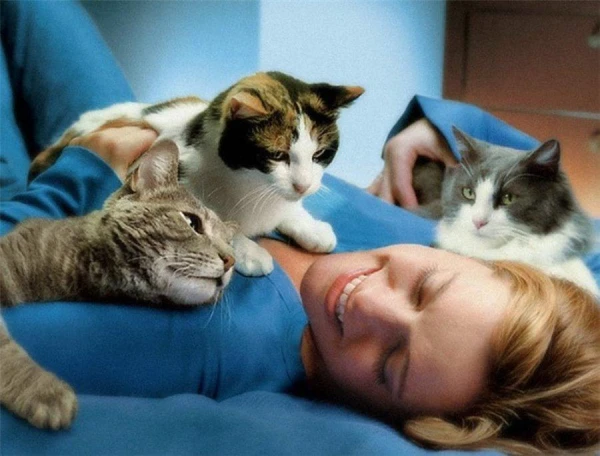
Cats are known for their independent and sometimes aloof behavior, but recent studies have shown how to become a true friend to them!
Researchers from the University of Nanterre in Paris visited a "cat café" to test various methods of attracting cats' attention. It was found that pets respond more quickly to strangers when they simultaneously use vocal and visual signals, such as calling them by name and extending a hand.
However, if a person completely ignores the animals, they most often start to wag their tails — a sign of frustration or excitement.
Ways Cats Communicate with Humans
Cats are known to have developed the ability to interpret human signals and respond to them during the domestication process.
Recent studies have shown that they can recognize their owner's voice when addressed directly, as well as perceive slow blinking as a sign of friendliness. Nevertheless, the authors of the new study note that the study of human-cat interaction remains limited at present.
In their work, the team aimed to determine how sensitive cats are to human signals, which of them are most effective, and how exactly they respond.
For the experiment, 12 cats were selected, living in one of two cat cafés in Bordeaux and Toulouse, France, for at least three years. Each cat was taken in turn to a quiet room with its owner, where a researcher awaited them, whom they had not met before.
After 10 seconds, the scientist performed one of four actions: provided a visual signal, a vocal signal, a simultaneous visual and vocal (bimodal) signal, or did nothing.
After analyzing the data, it was found that cats approached the researcher more quickly when a visual or bimodal signal was given. The authors of the study note that vocal addressing alone did not attract their attention, as cats are not used to being called without visual contact.
Additionally, it was observed that of all the reactions displayed by cats, they wagged their tails only in the absence of a signal from the person. Scientists emphasize that such tail movements usually occur when cats encounter an unpleasant situation.







Leave a comment