
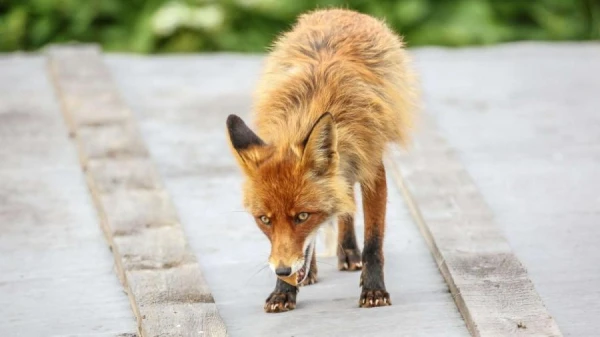
In the urban environment of Jelgava, various forest inhabitants — foxes, beavers, badgers, roe deer, and sometimes even moose — have been increasingly observed in recent years.
Animals in the City
According to the city council, residents should understand that if they see a wild animal in the city, they should not approach it, let alone feed it. If the animal is in a helpless state, it is necessary to report it to the Operational Information Center of the Jelgava Municipality Service by calling the resident support hotline at 8787.
It is important to consider that animals are smart and, if they accidentally wander into the city, they find their way back to their home — the forest. They are also capable of finding food on their own, so they should not be fed. Have you noticed foxes in your private sector or yard? Most likely, they are attracted by easily accessible food that you left outside for your pets. This easily available food in the city is one of the reasons why animals leave their natural habitat and enter urban areas. An overflowing trash bin is also attractive and tempting for wild animals, so it is crucial to prevent littering.
Foxes are most commonly seen in Jelgava, and, as noted by specialists from the Nature Conservation Service, foxes in urban environments are a normal occurrence, as food is available to them here, and the presence of people generally does not bother them. Therefore, in some cases, they have already chosen the city as their habitat. When residents see a fox in the city, they are advised not to act recklessly and under no circumstances attempt to make contact with the animal, maintaining a distance. Parents should also discuss this with their children. Although foxes are usually not aggressive towards people, it is important to remember that they are wild animals. In cases where an animal shows aggression or is in a helpless state, residents should report this to the Operational Information Center of the Jelgava Municipality Service by calling 8787.
The Food and Veterinary Service (PVD) emphasizes that the World Organisation for Animal Health (WOAH) has officially recognized Latvia as a rabies-free country. The last case of rabies in wild animals was recorded in 2010, and in domestic (pet) animals in 2012. The last cases of rabies in humans in Latvia were registered (one case per year) in 1993, 1996, and 2003.
Wild Birds in the Urban Environment
From time to time, residents express concern or anxiety about wild birds. Some find them too noisy, and sometimes their behavior seems unpredictable and potentially dangerous. Each problematic situation should be considered individually — what species of bird it is, how justified the complaint is, and how real the risk to the safety and health of people is. Keep in mind — it is prohibited to intentionally kill or capture wild birds, intentionally disturb birds, jeopardizing their conservation, and to keep birds of species for which hunting is prohibited.
Complaints are most often received about seagulls and crows. The Latvian Ornithological Society explains that a crow may either be protecting its nesting territory or aggressively demanding food — there can be several explanations for such behavior. To avoid an encounter with a specific aggressive crow, it is recommended to change your usual walking route.
Observations show that seagulls usually do not attack if they are not provoked. If seagulls nesting on the roof of a house are causing trouble, action should be taken in a timely manner. Usually, most problematic situations with birds end after the nesting period. The best thing to do is to prevent the construction of a nest: from the very first attempts, persistently and regularly interfere and do not allow seagulls to establish a nest. Once the seagulls start incubating their chicks, they will begin to defend themselves and may exhibit aggressive behavior. After the nesting period, when the young birds take flight, conflict situations near the nest usually cease. In a situation where the chicks have already hatched, do not disturb, provoke, or approach the seagulls — wait until the chicks grow and leave the nest, and then take measures to prevent nesting in that place in the future.










Leave a comment