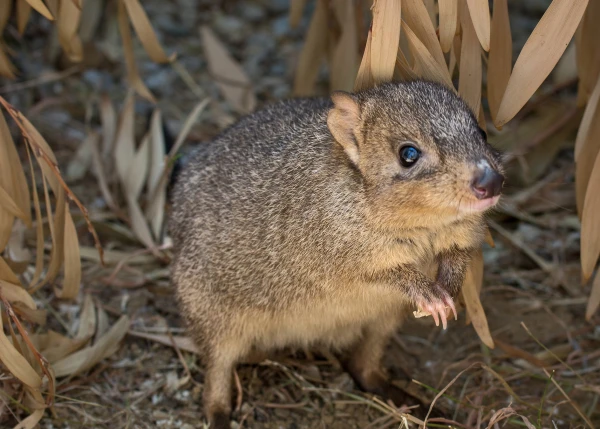
These little creatures love mushrooms, and drought harms them.
You have probably heard of kangaroos, wallabies, and quokkas.
Less known are their small and endangered relatives, the bettongs. These little marsupials love to dig and have a weakness for mushrooms.
Due to their size and relative rarity, it has always been difficult to accurately count how many different species of bettongs exist and where they inhabit.
Scientists believed that there were five modern species of bettongs, but a new study published in the journal Zootaxa changes our understanding of the diversity of these creatures. This knowledge may help explain why many attempts to protect them have failed.
For a long time, there were five recognized living species of bettongs: boodie, woylie, northern bettong, greater bilby, and eastern bettong. There are also several subspecies that are believed to have gone extinct due to feral cats and foxes. But the new study changes the situation.
Woylie is critically endangered: it is estimated that only about 12,000 individuals remain. Conservation efforts are focused on relocating individuals to areas where they are believed to have previously inhabited.
At least 4,000 woylies have been relocated to other habitats as part of conservation efforts. However, the new study shows that their range has always been limited to the southwest of Western Australia, and therefore some of the areas presented turned out to be uninhabitable. Bettongs that once lived in these places likely belonged to different species with different adaptations.
Woylies feed on mushrooms that are known to grow in moist forest floor areas. The northern bettong also specializes in mushrooms and is threatened by rising temperatures, which make mushrooms less accessible.
As woylies move from the southwest, they no longer have access to mushrooms, which are their food source. Some previous attempts to relocate individuals have been unsuccessful, and researchers are unsure why the animals could not survive in areas where they were believed to have previously inhabited.
Relocating individual animals can be a useful tool for both species conservation and ecosystem management. If a species is going extinct, it can be replaced by a similar species that will perform the functions previously carried out by the extinct species.
In the case of bettongs, it is about finding species that can fulfill this role and thrive in these arid ecosystems. This is worth doing as ecosystems suffer from their absence.
With the elevation of the brush-tailed bettong to a full species and the description of the little bettong, our findings add two new extinct species to the ever-growing list of extinct mammal species in Australia.
<iframe width="560" height="315" src="https://www.youtube.com/embed/Lm5JdL0Eujo?si=rjoqaMZS21FYNmhJ" title="YouTube video player" frameborder="0" allow="accelerometer; autoplay; clipboard-write; encrypted-media; gyroscope; picture-in-picture; web-share" referrerpolicy="strict-origin-when-cross-origin" allowfullscreen></iframe>