
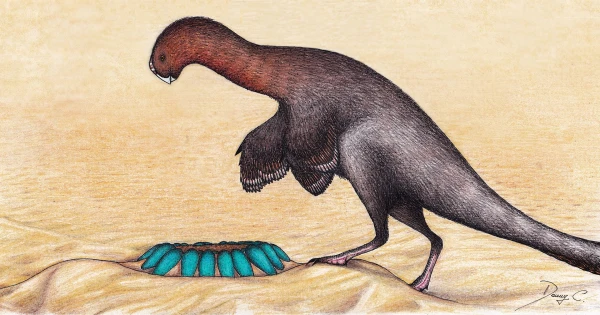
In a warm climate, oviraptors could actively utilize solar heat as an additional energy source.
In a new study published in the journal Frontiers in Ecology and Evolution, scientists from Taiwan analyzed the behavior of oviraptors, flightless dinosaurs with bird-like features, during incubation and the hatching characteristics of their offspring. They modeled the heat transfer processes within the nests and compared the hatching efficiency with that of modern birds. As part of the work, the researchers also conducted incubator experiments using life-sized models of oviraptor eggs.
The reconstructed oviraptor (Heyuannia huangi) inhabited what is now modern-day China approximately 70–66 million years ago. It is estimated to have reached a length of about 1.5 meters and a weight of around 20 kilograms. It built semi-open nests where the eggs were arranged in several concentric rings. For the experiment, the scientists created a model of the oviraptor's body: the frame was made of wood and polystyrene, while the "soft tissues" were made of cotton, fabric, and bubble wrap. The eggs were made from resin. In two experimental nests, they were arranged in double rings, as is presumed for actual oviraptor nests.
During the experiments, the researchers tested how the presence of an adult individual and different temperature conditions affected the hatching process. It was found that at lower temperatures and with the presence of an "incubating" adult, the temperature difference between the eggs in the outer ring could reach 6 °C. This likely led to asynchronous hatching – when chicks emerge at different times. In warmer conditions, the temperature difference decreased to 0.6 °C, indicating more uniform egg development. This suggests that in a warm climate, oviraptors could actively utilize solar heat as an additional energy source.
The scientists also compared the incubation efficiency of oviraptors with that of modern birds. Most birds use a method called contact incubation, where the adult directly warms all the eggs and maintains a stable temperature. For this, it is necessary for the bird to contact each egg and be the primary source of heat. In oviraptors, such conditions were not met: due to the nesting characteristics, the adult could not simultaneously warm all the eggs.
According to the researchers, oviraptors likely incubated their clutches less efficiently than modern birds. They probably combined the heat of their own bodies with external sources, such as solar radiation. This method cannot be considered worse – it is simply a different strategy that evolved depending on environmental conditions. The authors emphasize that their conclusions are based on the nest reconstruction and are limited by the fact that modern climate conditions differ from those of the Late Cretaceous period. Additionally, oviraptors likely had a longer incubation period than modern birds.
Nevertheless, the work expands our understanding of how these dinosaurs incubated their eggs. The methods used help connect physical models with paleontological data and open new opportunities for studying similar questions that were previously difficult to investigate.










Leave a comment