The great white shark is often referred to as the ocean's most formidable predator. "The top of the food chain," "the silent killer"... However, nature once again demonstrates that even absolute predators can become victims. In this article, we will discuss what happens when an orca attacks a shark.
Great white sharks and orcas are two extremely dangerous predators that, due to their size, belong to the category of marine super-predators. This group of organisms occupies the top positions in the food chain among predators, meaning their numbers are not controlled by other predators. But can they become victims at some point? For example, can an orca attack a shark, and what consequences would that lead to?
Great White Shark: Characteristics
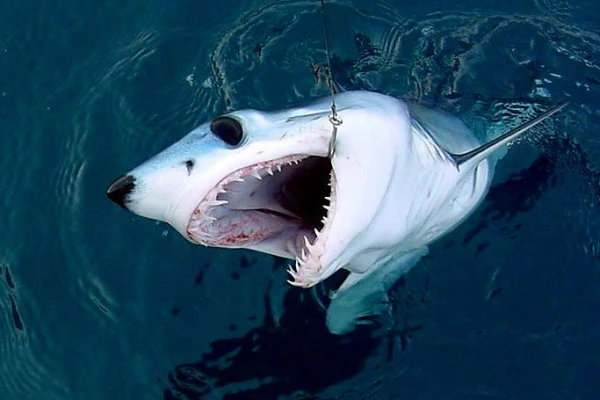
The great white shark (Carcharodon) is the largest of the currently existing predatory cartilaginous fish and is considered the most dangerous. Its ideal body shape, adapted for life in water, allows it to achieve high speed and maneuverability. Its extensive mouth with sharp teeth inflicts fatal damage on its prey, easily biting through bones and cartilage.
The size of an adult great white shark is 4–5 meters, and its weight ranges from 680 to 1100 kg. In 2007, scientists from the University of New South Wales (Australia) conducted a study of shark skulls using computed tomography, which allowed them to create a model to assess the force and dynamics of the bite. In 2008, they conducted an experiment that showed that the bite force of a 2.5-meter-long and 240-kg great white shark can reach 3131 N, while for a shark measuring 6.4 meters and weighing 3324 kg, it is 18216 N.
This predator has virtually no natural enemies, except for adult orcas.
Orca: Characteristics
Orcas are the largest carnivorous dolphins, distinguished from other dolphins by their contrasting black-and-white coloration. They exceed great white sharks in size: male orcas can reach 10 meters in length and weigh up to 8 tons, while females can grow up to 8.7 meters.
However, the threat to great white sharks does not come from all orcas. Ichthyologists, studying the lifestyle and behavior of orcas in the ocean, have conditionally divided them into two groups — resident and transient.
Resident orcas prefer to live in family groups and lead a sedentary lifestyle. Their hunting is also organized and collective. This type of orca may attack a great white shark if the pod is under real threat, for example, if there are calves or weak individuals that could become easy prey for sharks.
Transient orcas are more aggressive and carnivorous. Their victims often include marine mammals and sharks.
Who is Stronger — Shark or Orca?
When a pod of orcas appears, the great white shark prefers to avoid confrontation, but in the case of solitary individuals, its instinct for self-preservation may fail. Even a fleeing shark can be easily caught by an orca.
In a fight with sharks, orcas can use various tactics — delivering strong blows to unprotected gill openings or acting as a battering ram, crashing into the side of the predator. Hunting techniques may vary depending on the specific population of orcas.
Older individuals pass on their skills and hunting experience accumulated over a lifetime to their offspring. Therefore, young orcas act based on this knowledge.
It can be argued that the main advantage of orcas over great white sharks lies in their intelligence, which allows them to perform complex organized actions, adapting to specific situations.
Oceanographer Elton Polly spoke about how a pod of orcas pursues great white sharks off the coast of South Africa. This encounter occurred near Seal Island in Mossel Bay, where about 3000 Cape fur seals reside.
Due to the abundance of food (including other wild animals such as penguins), this location has become popular for great white shark hunting, as well as for tourists wishing to see these amazing creatures. However, this time, orcas spoiled the sharks' entire hunt. Researchers cannot say for sure whether it was a deliberate attack by the pod or just a coincidence, but one thing is clear: in conflicts between great white sharks and orcas, the latter has a certain advantage.
This is confirmed by a number of recent studies dedicated to the diets of marine predators. By studying shark carcasses washed ashore, oceanographers noticed that orcas enjoy feasting on their livers, which explains their eagerness to attack when they spot their favorite delicacy.