
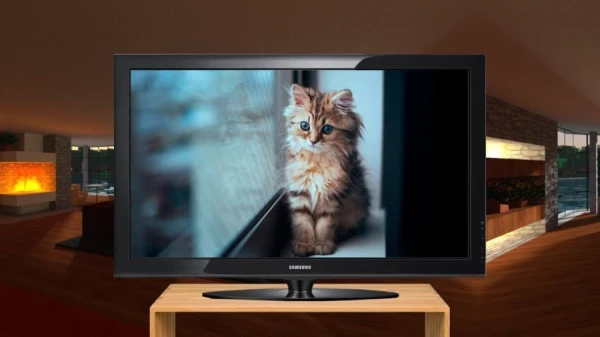
There are many videos online where pets watch a ball in a game being broadcast on television with interest. But are pets really capable of perceiving television? Do they understand what is happening?
In 2012, a commercial for Bakers dog food was released in the UK, created to attract the attention of four-legged friends! This ad used high-frequency sounds that are inaudible to the human ear. It was assumed that dogs would actively respond to the advertisement, which in turn would attract the attention of their owners. However, in practice, this did not work: many dogs showed no reaction to the television.
This case is quite indicative, as theoretically, dogs should be interested in unusual sounds. Why then did some of them not react to the advertisement but enjoyed watching videos about wild animals?
What Do Dogs See?
When it comes to color perception, television for dogs is no different from real life. They have dichromatic vision, which means they see the world in two primary colors — yellow and blue (unlike humans, who have trichromatic vision and can perceive the entire color spectrum).
It is believed that dogs also have slightly blurred vision, but more importantly, they process frame rates, or “flicker fusion,” of screens differently than humans. We perceive motion at a rate of 16 to 20 frames per second, while dogs require 70 frames per second or more. If they are watching an old television, it may remind them of a rapidly flipping book or even a strobe light. Modern televisions, with their higher frame rates, may be more appealing to dogs.
However, even if a dog sees an image, it does not guarantee that it will be interested in it. Typically, dogs respond to the same things that would attract their attention in real life. This includes not only visual signals but also sounds (such as barking, toy squeaks, or commands).
In a study published in the journal Animal Cognition in 2013, researchers observed nine dogs to determine if they could distinguish other dogs on a computer screen from other animals or humans. Despite the small sample size, the results showed that dogs are capable of recognizing their peers on screen. However, experts emphasize that this does not mean that a dog will always react to other animals on television. At some point, it may become insensitive to such signals and simply lose interest.
Interestingly, in a 2017 study published in the International Journal of Human-Computer Studies, researchers found that footage of other animals (not dogs) did not attract the pets' attention at all!
What About Cats?
In one study, researchers had 125 shelter cats watch television (up to three hours a day). The pets were divided into five groups, each shown different programs. On average, the cats spent only 6.1% of their time watching. When they did, they usually observed prey.
As it turns out, both dogs and cats are much more interested in what is happening in the real world. Perhaps we should learn from their zest for life!















Leave a comment