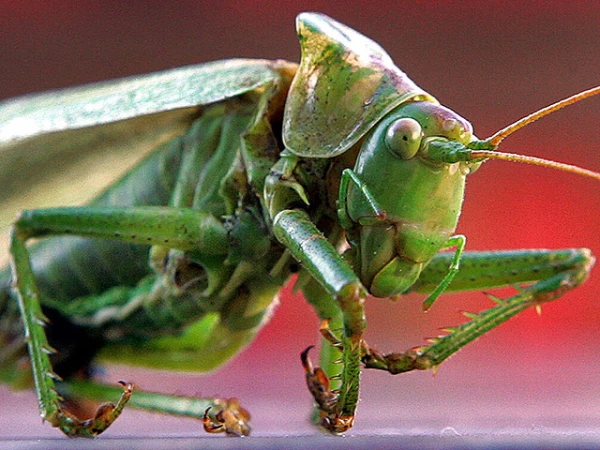
Chemical analysis revealed 907 different compounds secreted by the insect.
Using the migratory locust (Locusta migratoria) and the red imported fire ant (Solenopsis invicta) as a model system of "predator – prey," scientists conducted a series of behavioral tests, chemical analyses, and electrophysiological studies. Observations of colonies and individual ants during foraging showed that the regurgitation of locusts, as well as mealworms coated with this substance, significantly reduced the frequency of attacks from the ants.
Chemical analysis revealed 907 different compounds in the regurgitation; however, the protective effect was provided only by low-molecular-weight components, not proteins or volatile substances. Among them, diethylglutamate (DG), secreted by salivary glands, as well as 3-methylindole (3MI) and 2-(formylamino)benzoic acid (FBA), originating from the locust's crop, played a special role – this mixture proved to be effective in repelling ants.
Electrophysiological experiments showed that this mixture of chemicals activates the taste receptors of ants located on the sensilla of their antennae, causing them to exhibit pronounced aversion. Individual components, taken in natural concentrations, did not elicit such an effect, confirming that the protective action is based on the synergy of several substances.
The researchers also established that ants respond specifically to taste signals, not to smell. Electroantennograms (EAG) did not reveal any reaction from olfactory receptors, while recordings of the activity of individual sensilla (SSR) showed an increase in nerve impulses in response to the mixture. The complex of compounds elicited a response at much lower concentrations than each substance individually, indicating a synergistic effect: DG and 3MI act as primary activators, while FBA serves as an allosteric modifier that enhances their effect.
The findings deepen the understanding of chemical defense mechanisms in insects. Researchers are already studying similar strategies in other species. According to the researchers, their results, which identified the key protective mixture, may aid in modeling interactions in the "predator – prey" system. This is the first direct confirmation that regurgitation indeed serves a protective function.