This is the first documented hunting cooperation between two species of marine mammals.
Off the coast of Canada, marine biologists witnessed an unusual case. Orcas and dolphins joined forces to hunt Pacific salmon together. They dove into the dark depths and shared their food after a successful hunt. This is the first documented hunting cooperation between two species of marine mammals.
In the cold waters off the coast of British Columbia live 'resident' orcas (Orcinus orca ater). This is a specific subspecies of orcas (Orcinus orca) that primarily feeds on chinook salmon (Oncorhynchus tshawytscha) — the largest species of Pacific salmon.
In the same area, alongside Orcinus orca ater, swim Pacific white-sided dolphins (Lagenorhynchus obliquidens). They are much more social and communicative than orcas, preferring a more varied diet of herring and small fish.
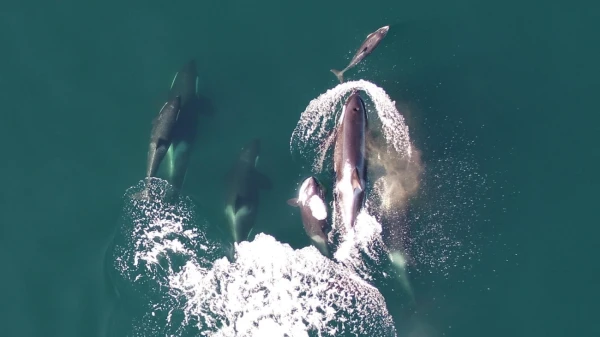
Extended observations from boats of Lagenorhynchus obliquidens showed that the dolphins swim just meters away from the orcas and are not afraid to be nearby. This discovery surprised scientists because different species of marine mammals usually either compete with each other or behave aggressively.
Scientists proposed two hypotheses. According to the first, the dolphins may use 'resident' orcas as a 'living shield' to protect themselves from more dangerous predators — Bigg's killer whales. This is not cooperation, but a one-sided survival tactic of the dolphins.
The second hypothesis states that the dolphins are likely just stealing food from the orcas. Such behavior, where one species benefits at the expense of another's labor without providing any benefit to the latter, in the case of orcas and dolphins — the appropriation of someone else's food, is called kleptoparasitism in biology.
However, both hypotheses had a significant flaw: they could not convincingly explain why territorial and zealous hunters — orcas — tolerated the presence of dolphins without showing any aggression towards them. Moreover, fully understanding the reasons for this peaceful coexistence was hindered by the environment itself: observations from the surface or boats did not provide a complete picture. The murky water and great depth at which the action unfolded concealed key details of the underwater interactions. Only technology helped to unravel this mystery, finally allowing a glimpse into the depths.
During fieldwork, scientists employed a comprehensive technological approach: drones for aerial photography, motion sensors and acoustic sensors, special telemetry tags, and compact cameras.
Using a long pole and suction cups, researchers attached equipment to the backs of nine 'resident' orcas swimming near the northern part of Vancouver Island. During the observation period, the Fortuna team recorded 258 instances of 'meetings' between dolphins and orcas, all occurring when the orcas were searching for, catching, or eating Pacific salmon. In 25 episodes when orcas encountered dolphins, they changed course and followed the dolphins. In total, orcas turned towards the dolphins 102 times.
But the most interesting events occurred underwater. Data from acoustic sensors and cameras showed that four tagged orcas dove together with the dolphins to depths of up to 60 meters — into the dark zone where large salmon hide among rocks and crevices.
This joint diving is an important stage of the hunt. Chinook salmon can reach nearly a meter in length and often dive to depths where there is almost complete darkness. At this moment, echolocation came into play.
Analysis of the acoustic data revealed an interesting detail: in the presence of dolphins, orcas often reduced their own active echolocation to 'eavesdrop' on the dolphins' clicks. If the echolocation of an orca resembles a 'flashlight beam', then dolphins scanning the water act like a 'searchlight', significantly expanding the acoustic 'field of view' and helping to detect prey more quickly.
When the hunt was successful, a stage occurred that is difficult to explain by mere proximity. The orca would grab a large chinook salmon, bring it to the surface, and tear it apart to share with members of its family group. At this moment, the dolphins appeared. They swam up to the orca's head and picked up the leftover fish.
For dolphins, chinook salmon is too large to catch and swallow whole, so such scraps are a valuable food source. Meanwhile, orcas, who usually zealously guard their catch, showed no aggression towards the pesky dining companions.