
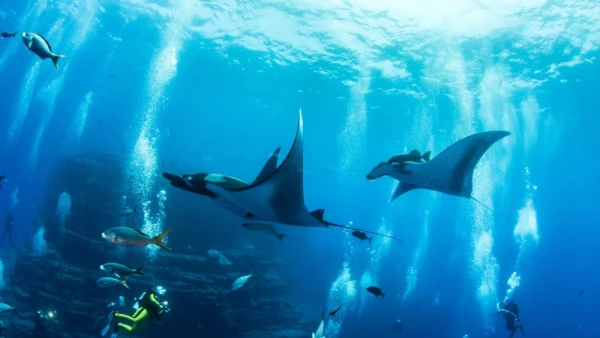
Scientists have revealed the mystery of the deep-water dives of giant manta rays. It turns out they are capable of diving to a staggering depth of over 1200 meters. Previously, no one even suspected that these marine creatures could go so low.
An international group of researchers has been observing oceanic manta rays in Peru, Indonesia, and New Zealand for several years. To understand the behavior of the rays, they equipped 24 individuals with special tags. The results of the study were published in the journal Frontiers in Marine Science.
"We showed that in the open ocean, oceanic manta rays are capable of diving to depths of over 1200 meters, which is much deeper than previously thought," said lead author Dr. Calvin Beal from Murdoch University (Australia).
The work was painstaking. From 2012 to 2022, the team tracked the movements of the rays. Some of the tags, programmed for automatic detachment, had to be found in the ocean — a challenging task.
In the end, a vast array of data was collected — observations were conducted for a total of 2705 days. During this time, 79 extreme dives to depths of over 500 meters were recorded, with a record depth of 1250 meters. Most of these deep dives — 71 — were made by rays in the waters of New Zealand.
After analyzing the data, the researchers made an intriguing discovery. It turned out that New Zealand mantas dive to depth shortly after leaving the continental shelf and entering the open ocean. The dive itself appears to be stepwise, and the rays spend little time at maximum depth. This suggests that they are not diving for food or to hide from predators. The scientists speculate that this is how the giants "read" the Earth's magnetic field.
"This way, they can create a mental map that helps them navigate across vast, featureless areas of the open ocean," explains Beal.
At great depths, where the environment is more stable than at the surface, navigation is easier. After such a dive, the rays gradually ascend and take a long time to recover at the surface, after which they can cover more than 200 km in a few days. How marine animals swim thousands of kilometers without getting tired can be read here.
So why do rays off the coast of Peru and Indonesia hardly dive so deep? It's simple — they don't need to. In the area of the Indonesian archipelago of Raja Ampat, for example, the sea is mostly shallow. In New Zealand, however, rays live in areas where the seabed drops sharply into the depths, making navigational dives a necessity.














Leave a comment