
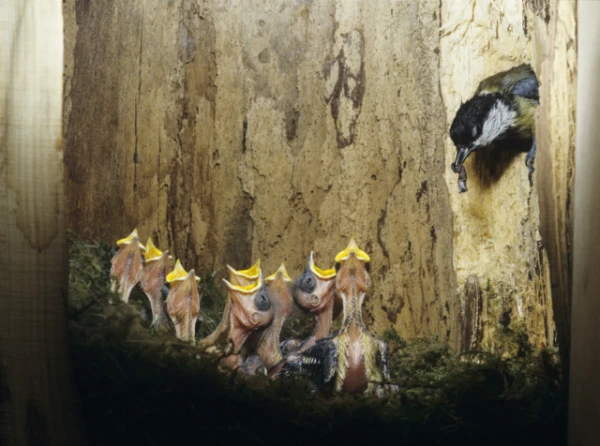
Researchers from the University of California and the Max Planck Institute for Animal Behavior found that young tits acquire vital skills not so much from their parents, but from their siblings and neighboring adults.
Unlike species where parental care lasts a long time, in tits it lasts only about ten days after hatching — then the chicks are forced to act independently.
Using automatic feeders and microchips, researchers tracked how young birds acquire new skills. It turned out that the example set by parents only encourages chicks to make initial attempts, but they predominantly adopt specific strategies from siblings and unrelated adults. Almost 94% of the chicks replicated the solutions of their brothers and sisters. This explains why family behavior is transmitted through social learning rather than solely through direct upbringing.
Such "social learning networks" make populations more resilient to environmental changes and facilitate adaptation. The findings are important for conservation: maintaining mixed-age groups and preserving family ties help young birds learn and survive more effectively in challenging conditions.












Leave a comment