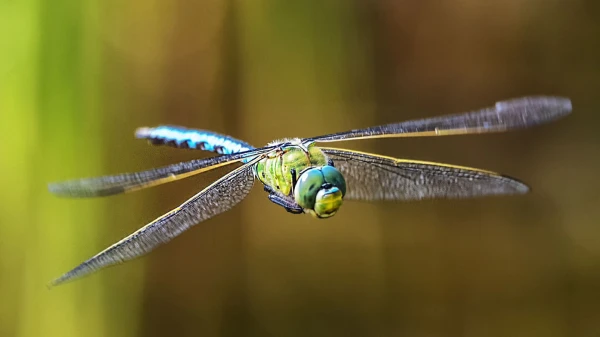
These insects are found all over the world, except Antarctica — from North America and Europe to Australia and Africa. But swarms of them can only be seen in warm weather. How do dragonflies manage to survive the cold?
How the Life Cycle of a Dragonfly Works
Before discussing wintering, it is important to understand the life cycle of a dragonfly. These insects are amphibionts, meaning their life is inextricably linked to both water and land. Their development occurs through incomplete metamorphosis — without a pupal stage.
Egg. It all begins by the water. The female dragonfly lays eggs in the water or in the tissues of aquatic plants. Some species do this in the fall, and the eggs remain to winter in the water, reliably protected from frost by the thickness of water and ice.

Larva (naiad). The larva emerges from the egg, which can live in water for several months to several years. It is a voracious and remarkably adapted predator. With the help of a special “mask” — a folding organ with claws — it swiftly grabs its prey: from aquatic insects and mosquito larvae to tadpoles and fish fry.

Imago (adult). After several molts, the larva climbs out of the water along a plant stem. The final molt occurs, and a winged, incredibly fast dragonfly emerges. The adult life of the imago, depending on the species, lasts from several weeks to several months.
How Dragonflies Survive Winter
As the cold sets in, different species of dragonflies and even different generations of the same species employ one of three survival strategies.
Entering Dormancy, or Diapause
Many dragonflies in temperate latitudes survive the winter in a state of diapause — a special form of dormancy where metabolism slows down. Most often, it is not the adult individuals that enter dormancy, but the eggs or larvae. They are securely hidden in water, silt, or plant debris, where the temperature rarely drops below -4°C, allowing them to wait for spring.
However, there are exceptions. For example, the red darner — a dragonfly that does not perish in winter but enters dormancy in its adult stage, hiding in secluded places: under tree bark, in hollows, or under fallen leaves.
Wintering in an Active State
The second strategy is to wait out the cold where the insect was caught. Many larvae remain in water bodies for the winter.
Water cools down more slowly than air, and the ice that forms on the surface acts as a kind of insulator, protecting against frost. Some adult dragonflies, such as the green darner, can also winter in sheltered places, entering a state of torpor.
Migration
Some adult dragonflies prefer not to fight the cold but simply fly away from it. Typically, species that inhabit the Northern Hemisphere migrate. A striking example is the wandering glider — a true record holder in the insect world. Every year, millions of these dragonflies undertake flights from Southern India to Africa and back, covering distances over open ocean ranging from 14,000 to 18,000 km!
How Dragonflies Manage to Migrate Long Distances
Dragonflies are among the most advanced fliers on the planet. They masterfully control their bodies. Two pairs of wings can work independently of each other, allowing the dragonfly to fly backward, sideways, make sharp turns of 360°, and hover in the air. This maneuverability is indispensable for long journeys.
Dragonflies fly at great heights, crossing oceans and mountain ranges. Although their usual speed is about 30–40 km/h, some species can accelerate to 56 km/h or more.
Scientists believe that for orientation, dragonflies use the position of the sun and possibly the Earth's magnetic field. Their large compound eyes, providing nearly panoramic vision, help them spot both prey and predators in time.
When and Where Dragonflies Migrate
Migration routes most often lead from tropical and subtropical regions to temperate latitudes and back. However, dragonflies do not always fly far. For example, the green-eyed skimmer migrates within continents.
Dragonflies head south from August to late October. But what is most interesting is that the dragonflies returning in spring are not the same individuals that flew away in the fall. The life of an adult dragonfly is short — only a few months. Therefore, the grand migration cycle, spanning thousands of kilometers, is completed by at least two generations. The autumn migrants, having flown south, manage to lay eggs there and die. The next generation, having hatched and matured, heads north in spring to repeat the feat of their parents.