
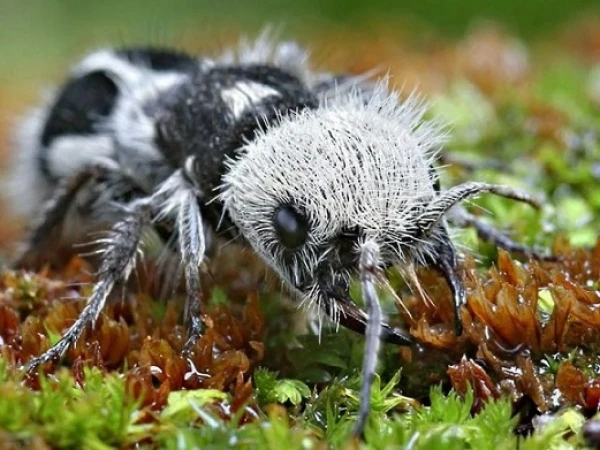
Despite the name, the panda ant is not an ant at all. This unique insect belongs to the family Mutillidae—a group of wasps known for their bright coloration and painful stings. Externally, the females of this species do resemble small pandas due to their fluffy white bodies with distinctive black spots. However, their appearance is not just a tribute to beauty, but an important element of survival in nature.
Amazing Coloration and Defensive Mechanisms
The black-and-white coloration of the panda ant serves as a warning to predators. It signals that the insect possesses a powerful venomous sting. Although the venom is not lethal to humans, its stings are considered extremely painful. A feature of panda ants is that their stinger is smooth, allowing them to sting multiple times in succession, unlike bees, which lose their stinger after an attack.
The females of these wasps are wingless, making them resemble ants. This is why they have received their unusual name. Males, on the other hand, have wings and can fly, although their coloration is less vivid and not as remarkable.
Lifestyle and Reproductive Features
Panda ants inhabit Chile and predominantly lead a solitary lifestyle. They do not form colonies like true ants or social wasps. One of the most interesting aspects of their behavior is the mating process. Winged males catch wingless females right in the air. The exact reasons for this behavior remain a mystery, but scientists propose several hypotheses. It may be related to the need to avoid predator attacks, prevent competition from other males, or simply to keep the female from escaping.
After mating, the females burrow underground, where they search for the nests of other insects. There, they lay their eggs. When the larvae of the panda ants hatch, they consume the larvae of the host nest. In two years of life, a single female can produce up to 2000 eggs, making this species quite prolific.
Unique Communication Method
Another amazing feature of panda ants is their ability to produce sounds that reach ultrasonic frequencies. These sounds serve to deter predators or attract mates for mating. The insects create noise by rubbing their legs or antennae against each other. Such a communication mechanism is rare and underscores the uniqueness of this species.
Why Is This Important?
Panda ants are a striking example of how nature creates amazing mechanisms of defense and adaptation. Their coloration, behavior, and even their method of communication demonstrate complex interactions between organisms and their environment. Studying such species helps scientists better understand the evolution of insects and their role in ecosystems.
So, the next time you hear the term "panda ant," remember: it is not an ant, but an amazing wasp that combines features of different animals and possesses unique characteristics, making it one of the most interesting insects on the planet.













Leave a comment