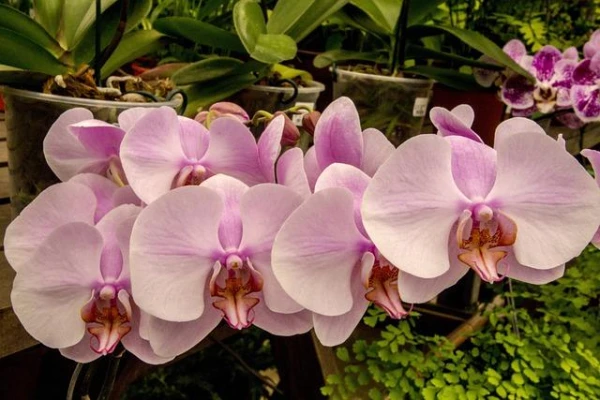
Orchids are one of the most sought-after houseplants. They require little care and easily adapt. However, the process of their blooming raises many questions among enthusiasts.
The term "orchid" encompasses about 25,000 species and just as many hybrids from the orchid family (Orchidaceae), including the genus Phalaenopsis. Phalaenopsis is the most common houseplant among orchids, as it is best adapted to the temperature conditions of our homes and requires relatively little light. Few other species can boast such a long flowering period.
The Phalaenopsis orchid was first described by the German botanist Karl Blume in 1825 on the Indonesian island of Ambon. He observed the jungle through binoculars and mistook a group of white flowers for butterflies, which gave the genus its name (from the Greek phalania — "moth") and the species epithet (from the Greek opsis — "appearance").
Although there are other species of orchids, we will focus on Phalaenopsis, as they are the most popular and most research has been conducted on them. So how can you make these plants bloom more often and produce more flowers?
Ways to Activate Orchid Blooming
The key to getting more flowers is proper orchid cultivation. Large plants with developed leaves are capable of producing more flowers. A plant with five or more leaves usually blooms easily, although specimens with fewer leaves can also do so. However, plants with small leaves or weak root systems generally do not bloom or produce very few flowers. The first step is to learn how to provide the orchid with suitable temperature and light conditions. Proper watering promotes healthy growth and the formation of a strong root system.
The new leaves of these plants should be no smaller than the old ones. If they become smaller, it may indicate that the conditions in your home do not quite meet their needs. In laboratory conditions, Phalaenopsis that received sucrose through foliar spraying began to bloom earlier when comfortable temperatures were maintained. Healthy plants contain more natural sugars.
Phalaenopsis grow well in low light, allowing them to develop and bloom even in relative shade. However, this does not mean that they will thrive in insufficient light. These flowers need more light than most houseplants. Many common recommendations state that they should not be placed in direct sunlight, but this is not entirely true — to encourage the plant to produce more flowers and bloom more frequently, it is necessary to provide it with adequate light. It is important to remember that too much bright sunlight can cause burns on orchids.
Bonus: 5 Interesting Facts About Phalaenopsis
In nature, Phalaenopsis are found in the tropical and subtropical regions of Southeast Asia, including Indonesia, the Philippines, Malaysia, and Thailand.
They can live up to 70 years.
These flowers appeared on Earth long before dinosaurs.
In Ancient China, Phalaenopsis symbolized harmony, longevity, and prosperity.
The seeds of Phalaenopsis are so tiny that they cannot be seen without a microscope.