
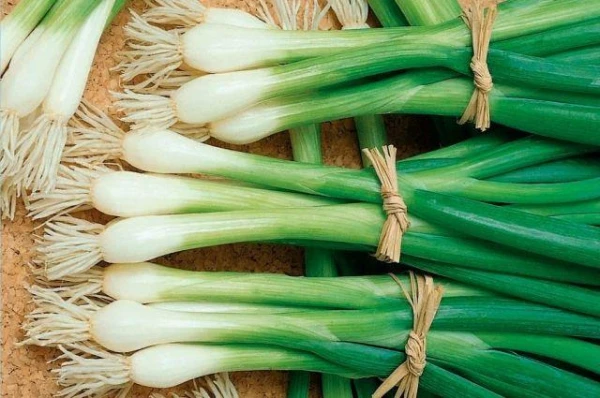
This question is answered by experienced gardener and agronomist Alexander Khorobrovets.
- To achieve high yields of bunching onions, it is necessary to use well-prepared, structured, and fertile soils with a medium mechanical composition. Heavy clay soils are not suitable for its cultivation. Bunching onions grow reasonably well in sandy soils; however, they quickly produce many flower stalks.
Depending on the soil fertility, organic fertilizers (60-100 kg per 10 m²) and mineral fertilizers (0.2-0.3 kg of ammonium nitrate, 0.3-0.4 kg of superphosphate, and 0.1-0.2 kg of potassium chloride per 10 m²) are applied in the year of sowing. Manure, peat compost, as well as 2/3 of the superphosphate and potassium chloride should be applied in the fall. The remaining fertilizers are added in the spring.
On acidic soils, especially with perennial cultivation of bunching onions, liming is necessary. Depending on the level of acidity and the mechanical composition of the soil, 2 to 5 kg of lime is applied per 10 m².
Bunching onions can be cultivated in a one-year, two-year, or perennial system. In one-year cultivation, sowing is done in early spring to harvest in August along with the false bulb. In the case of a two-year crop, the onions are left to winter and harvested in June or July of the following year. The optimal time for sowing bunching onions in perennial cultivation (over three years) is July, as during this period the plants are less prone to bolting compared to early spring sowing.
In vegetative propagation, the best time for planting is August. Bunching onions can also be successfully propagated by seedlings, which are grown for 50-60 days in greenhouses or hotbeds.









Leave a comment