Tips from agronomist Alexander Khorobrovts.
Start by reducing the height of the tree and ensuring light access into the crown. To do this, it is necessary to prune part of the central leader or a branch replacing it. The pruning location should be determined individually in each case. If the tree's condition allows, it is better to make the cut at a height of about 2 meters. If a lot of growing branches are removed during such pruning and the tree becomes significantly bare, then the height reduction should be done gradually over 3–4 years. In the upper part of the crown, branches should also be pruned, redirecting them to strong horizontally positioned branches.
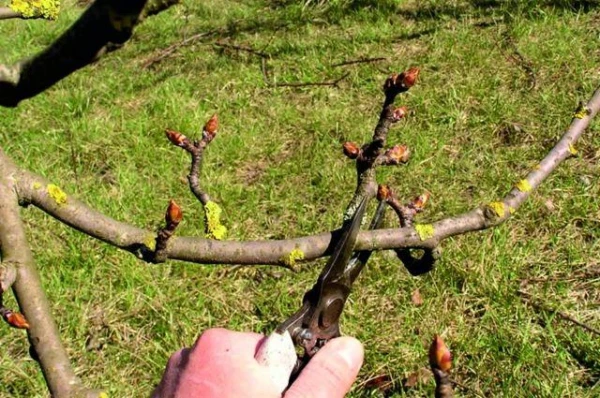
Drooping branches need to be lifted. For this, make cuts on strong vertical branches. When significantly reducing the crown, thinning is not recommended unless absolutely necessary. It is better to postpone this work until the following year. When thinning, as in similar cases, the desired result should be achieved by removing several large branches. After reducing the crown and thinning, if the tree shows weak growth, rejuvenation of the remaining branches and detailed pruning of the growing branches should be carried out.
After reducing the crown, many water sprouts will appear in its upper part. To prevent them from taking nutrients and forming a new crown above the main one, unnecessary water sprouts should be broken off. Water sprouts that form on bare areas of branches can be used to rejuvenate old branches or to form new growth wood.
GLOSSARY
Water sprouts are strong vertically growing shoots that differ in large leaves compared to other branches. They grow from dormant buds.