An experienced gardener, agronomist Alexander Khorobrovets shares.
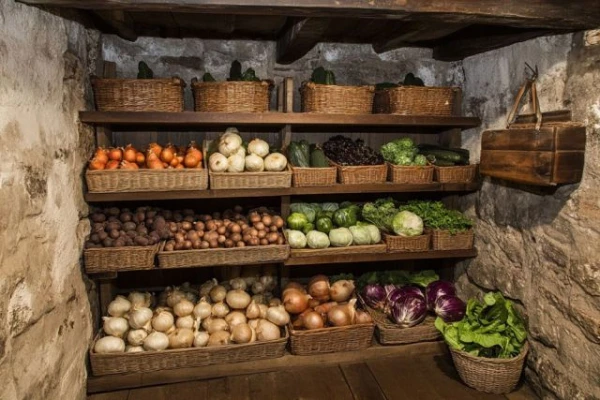
- Currently, cellars are mainly built from brick or concrete, which should have good hydro and thermal insulation.
Cellars are equipped with ventilation and double doors. For waterproofing, materials such as roofing felt, bitumen, clay, and others are used. The best insulating materials are the most accessible ones, such as forest moss, oak leaves, expanded clay, etc.
The floor in the cellar is recommended to be covered with draining materials: coarse sand, fine brick rubble, expanded clay, gravel. Then it is covered with sand (2-3 cm) or, in extreme cases, a thin layer of lean concrete (1:6). However, as practice shows, replacing the sandy floor covering with concrete increases the moisture content in the cellar, leading to condensation on the ceiling and the formation of dripping moisture.
To remove excess heat, moisture, as well as carbon dioxide and other gas exchange products released by tubers and vegetables during respiration from the cellar, a supply and exhaust ventilation system is installed.
The exhaust ventilation pipes should be located in the roof of the storage as close to the ridge as possible and 70-80 cm above the roof. In case of condensation, excess humidity is removed by enhancing ventilation. The relative humidity of the air in the cellar should be within 75-95 percent.
If it is impossible to eliminate the condensation on potato tubers through ventilation in the cellars, it is recommended to cover the top layer of potatoes with moisture-absorbing materials (bags filled with straw, shavings).