
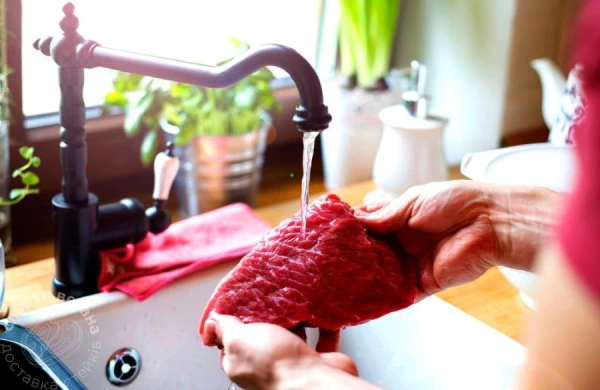
The question of whether to wash raw meat continues to spark debates among amateur cooks. Opinions among specialists and scientists on this matter also vary.
It seems that there is no point in worrying about this if the products will be subjected to heat treatment, and all dangerous bacteria or viruses should die. If the meat looks clean, the chicken carcass is impeccable, and the eggs are snow-white — should they be washed additionally?
What are the arguments “for” and “against” this process? About this, Evgeny Shapovalov, an infectious disease specialist and pediatrician, told “Doctor Peter”.
“It Can Be Dangerous”: Arguments “Against”
The habit of washing meat products before heat treatment is often explained by the desire to remove pathogenic bacteria that may be present on livestock and poultry. However, doctors emphasize that it is impossible to completely remove pathogenic microorganisms from the surface of products.
“In this context, the only way to make a dish safe is to pay due attention to heat treatment, especially when it comes to chicken or pork. In terms of the risks of salmonella infection, undercooked chicken breast will be more dangerous than unwashed,” warns Evgeny Shapovalov.
Moreover, the habit of washing meat can turn out to be not only useless but also dangerous.
“Bacteria can easily move from the product to the sink, as well as to nearby kitchen surfaces and utensils — dishes, knives, and even other products. It will be extremely difficult to remove them later, especially if you do not have the habit of disinfecting the kitchen with antiseptics after each cooking,” says the doctor. — “This creates a risk of cross-contamination, when bacteria get onto other food products.”
Studies in the United States have shown that washing chicken increases the likelihood of salmonellosis by 25%. At the same time, the main source of contamination becomes other products that bacteria get onto during the washing of meat.
“Arguments against washing meat most often relate to those products whose origin we know 100%, — continues the doctor. — For example, in some countries, up to 50% of the meat available for sale is labeled as “organic”. Its production, packaging, and transportation are subject to strict regulations, and quality is guaranteed by high standards.”
Not Only Wash but Also Soak: Arguments “For”
In Russia, there is currently no such well-established system as in the West. Often we cannot be sure of the conditions in which livestock or poultry were raised, whether potentially harmful additives were used, or how the finished products were stored, notes the expert.
“Therefore, it is not worth neglecting the preliminary processing of meat before cooking, — believes the doctor. — Moreover, it is better not just to wash but to soak in water for 15–20 minutes. This will help not only to remove dirt and foreign particles (for example, bone or cartilage fragments) but also to cleanse the product of excess preservatives and antibiotics that may be used by the manufacturer.”
For the same reason, when preparing soups, the first broth should always be drained after boiling, and the meat should be covered with clean water. This is especially important if the soup is being prepared for children, but this measure will not be superfluous for adults either, the pediatrician clarifies.
For Eggs — A Strict Rule
It is worth mentioning separately about eggs, which are one of the main sources of salmonella bacteria contamination.
“Eggs are always washed, and it is mandatory to use warm water with soap, — continues the specialist. — The main thing is to do this just before cooking, not in advance. During storage, microcracks may form on the shells of washed eggs, through which bacteria from the surface can enter inside.”
It Is Important to Know
To prevent infections, it is extremely important to follow personal hygiene and food preparation rules.
The first and foremost is to always wash your hands with soap before and after contact with raw meat. This will help avoid cross-contamination of other products. It is equally important to regularly clean the kitchen.
It is better not just to wipe the countertop and sink but to rinse them with warm water and detergent.
Another rule concerns cutting boards and knives: there should be separate ones for each type of product in the kitchen. Cutting vegetables on a board where meat is usually processed, or even just using the same knife — is not only unhygienic but also dangerous.








Leave a comment