
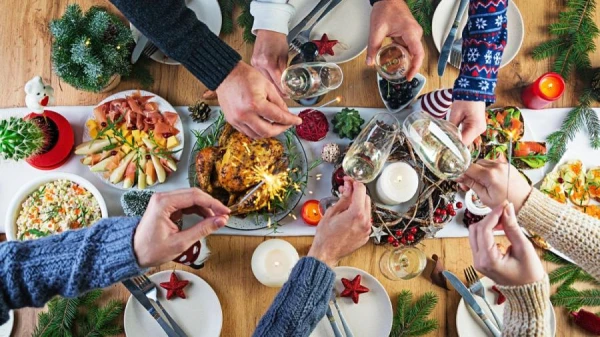
New Year holidays, during which various salads, snacks, and hot dishes are consumed in combination with alcoholic beverages, tangerines, and sweets, can negatively affect even the healthiest digestive system.
How to avoid overeating, and if it has already happened, what to do to restore the body?
The Principle of One Tablespoon
During the holiday season, there is a redistribution of consumed products towards carbohydrates, leading to a sharp increase in their levels in the blood, followed by a similarly sharp decrease after insulin is released. “This 'rocking' of the pancreas can become an additional risk factor for developing diabetes in the future, especially in the presence of predisposition,” explained Elena Averyanova, a candidate of medical sciences and gastroenterologist.
Holiday feasts put significant stress on the entire gastrointestinal tract. The liver bears the heaviest burden, as it is subjected to not always healthy food, along with alcohol, including carbonated drinks. Of course, the gastroenterologist says, it would be naive to hope that everyone will immediately switch to zucchini and celery, but knowing the limits is still necessary.
In particular, it is not advisable to prepare all dishes for the New Year's table at once. It is better to limit oneself to a few treats, while the rest can be prepared later, for Christmas, Old New Year, or Epiphany. This will help avoid overeating on New Year's Eve and eliminate the need to finish salads that have been sitting in the fridge for two days.
If the table is overflowing with dishes and there is a desire to try everything, it is worth adhering to the principle of one tablespoon. “Take a tablespoon and serve a little of each dish, preferably not all at once. Try to combine proteins with proteins and carbohydrates with carbohydrates. It is not advisable to eat cake right after fried chicken. Remember that what you have eaten still needs to be digested by your body,” recommends the doctor.
It is advisable to take breaks between meals. For example, you can start on sweets after a short walk.
On Water and Buckwheat
If you couldn't hold back on New Year's Eve, the doctor recommends using two proven methods. The first is to provide the body with enough water. Not tea, coffee, or juices, but specifically water. “This is the first thing your body will say a huge 'thank you' for,” assures Elena Averyanova. “Thanks to water, all undigested products and toxic substances formed during excessive eating will be eliminated from the body.”
The second method is to arrange several unloading days. As an option, you can 'sit' on buckwheat porridge for a couple of days. This is suitable for everyone except people with diabetes. If there is no heartburn, kefir can be added to this menu. “Two days will be quite enough,” says the gastroenterologist. “During this time, most harmful products that can cause colitis, gastritis, and pancreatitis will leave the body.”
It is not advisable to engage in sports or start a diet immediately after the New Year holidays. With the latter, one should be especially cautious, especially in winter. In cold weather, the body already spends more energy to maintain warmth, and it is not worth depriving it of food. Additionally, in our latitudes, there is a lack of sunlight, and many diets involve limiting fats, which can further decrease the level of fat-soluble vitamin D.
“Any diet should be discussed with a treating physician,” warns the expert. “It depends on many factors: metabolism, gender and age, chronic diseases, genetics, body mass index, fat and muscle mass ratio. It is very individual. Thoughtlessly starting a 'mass diet' is a disrespect to oneself.”
According to a doctor from Pskov, the number of visits to gastroenterologists significantly increases after the New Year holidays. “There are people who limit themselves in food by a doctor's prescription, but during New Year, which happens once a year, they break down. They reason something like: 'Well, nothing will happen if I eat herring,'” the doctor recounts.
However, one herring can seriously spoil life, especially for someone with ulcer and gallstone disease.
Health is the Main Capital
A separate topic is alcohol. At the festive table, it is better to limit oneself to 100–150 grams. “This is a sufficiently safe dose, provided there are no chronic diseases, which will be enough for enzymes, and the digestive system will not be overloaded, allowing it to digest other foods,” advises Elena Averyanova.
Consuming low-quality alcohol can lead to necrosis of the pancreas.
It is not advisable to mix drinks. Often, the celebration starts with champagne, then moves to wine, and ends with cognac or something even stronger. According to the doctor, the pancreas simply does not have time to produce enough enzymes to break down the toxins.
“Alcohol is a poison, no matter what they say,” believes Elena Averyanova. “To cope with it, the pancreas and liver, so to speak, temporarily forget about everything and start working only to eliminate this problem. If you add a carbonated drink and 'Olivier' to this, there may simply not be enough enzymes for the latter, and at best, you will face diarrhea.”
Fortunately, according to the doctor, many have become more conscious about their health, understanding that it is the main capital.






Leave a comment