
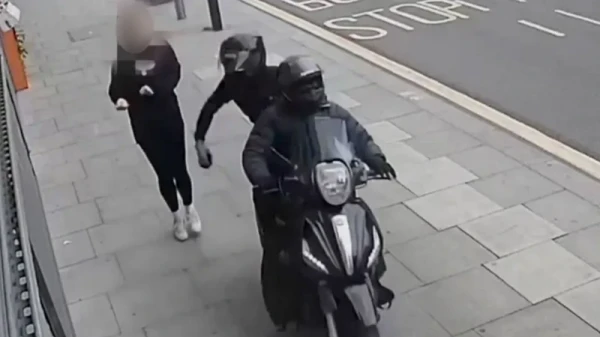
The police did not immediately realize that the incidents were systematic and that organized crime was behind them.
In the first two months of this year, the London police arrested 248 people who are accused of involvement in mobile phone theft. This is one of the most widespread crimes in cities across the UK, especially in the capital, in recent years — thieves are interested not only in the phones themselves but also in SIM cards. Devices can be sold, and access to SIM cards can open up banking applications to criminals, and there have already been cases where passersby, left without smartphones, soon lost thousands of pounds from their accounts. British media refer to the scale of the theft as an 'epidemic.'
The police did not immediately realize that the thefts were systematic and that organized crime was behind them — often, phone thefts were not even seriously investigated, as they fell under the category of petty crimes.
Now they are confronting thieves with the help of drones and electric scooters.
Some criminals operate in busy areas during the morning rush hour because they need to hurry to school — for classes.
'And Very Ruthlessly'
Cambridge resident Fenella Rowling lost her iPhone 16 during a routine shopping trip. She regrets the photos of her mother, who is suffering from cancer, stored there the most — she did not have time to set up cloud storage for her photos.
After opening the 'Find My iPhone' feature on another device, she discovered that her smartphone had flown from the UK to Dubai a week later, and then to China. After that, Rowling received a whole wave of phishing messages. She was asked to reset her settings, disclose her information, or erase it.
Christian D'Ippolito, the founder of a charity to help vulnerable youth, had his phone snatched in the London district of Hackney. Moreover, the device was unlocked at the time of the theft.
He did not manage to get to his computer to reset the settings, and as a result, the criminals accessed his business bank account and the PayPal money transfer service. D'Ippolito ultimately estimated his losses at 'tens of thousands' of pounds. 'It’s just incredible how <…> they can take literally everything you have, and very ruthlessly,' he said.
Mobile phone thefts in London were counted in the tens of thousands even in the 2010s. However, the increase in such crimes is so stable that this phenomenon is already referred to as an 'epidemic.'
In 2020, the London police recorded about 28,600 thefts, and by 2024, this number had risen to around 80,500 — and this is only for registered crimes.
At the same time, such thefts were classified as petty crimes, and the metropolitan police warned back in 2017 that they did not have the resources to investigate them.
The turning point occurred only in 2024. A person contacted the London police, stating that he was able to track his stolen smartphone, and it was located in a warehouse at Heathrow Airport.
The arriving law enforcement officers discovered a box labeled 'batteries,' which was supposed to be sent to Hong Kong. Inside were 894 phones — and almost all of them were stolen.
Soon, the police found several more boxes, forensic analysis helped identify the first suspects, and this ultimately led to the largest operation.
Eighteen people were arrested, suspected of being part of an international gang involved in the theft of about 40,000 phones — about 40% of all stolen in London.
Some devices were wrapped in foil before attempts to send them to other countries to make them harder to track.
The police tracked down one of the suspects who purchased foil rolls totaling about 2.4 km in length from a hardware store.
Why Do You Need Someone Else's Smartphone
London police representative Sarah Jones stated that stealing phones can be more profitable for criminals than drug trafficking, and they are switching to this type of illegal business.
The cost of the phones themselves is relatively low; they can be sold in London at one of the numerous second-hand electronics shops — their purchase price will range from several dozen to several hundred pounds.
If stolen smartphones end up in China, their price can reach even £4,000 ($5,400) for a new device. This is explained by the fact that Western smartphones do not have censorship mechanisms and provide full internet access. Plus, while in Western countries a device can be blocked as stolen, in China such a block will not work.
The 'epidemic' of phone theft has reached such proportions also because this crime combines ordinary street theft and cyber fraud. Gaining access to a SIM card, criminals try to obtain maximum access to all the contents of the smartphone. For example, they can penetrate banking applications using codes from SMS messages.
If such penetration is successful for the criminals, victims face losses that will far exceed the cost of any new device.
Londoner Christian D'Ippolito reported that in addition to directly stealing his money, the criminals also tried to take out a loan in his name — it is easily done online, and banks assume that their mobile application is being used by the actual account owner.















Leave a comment