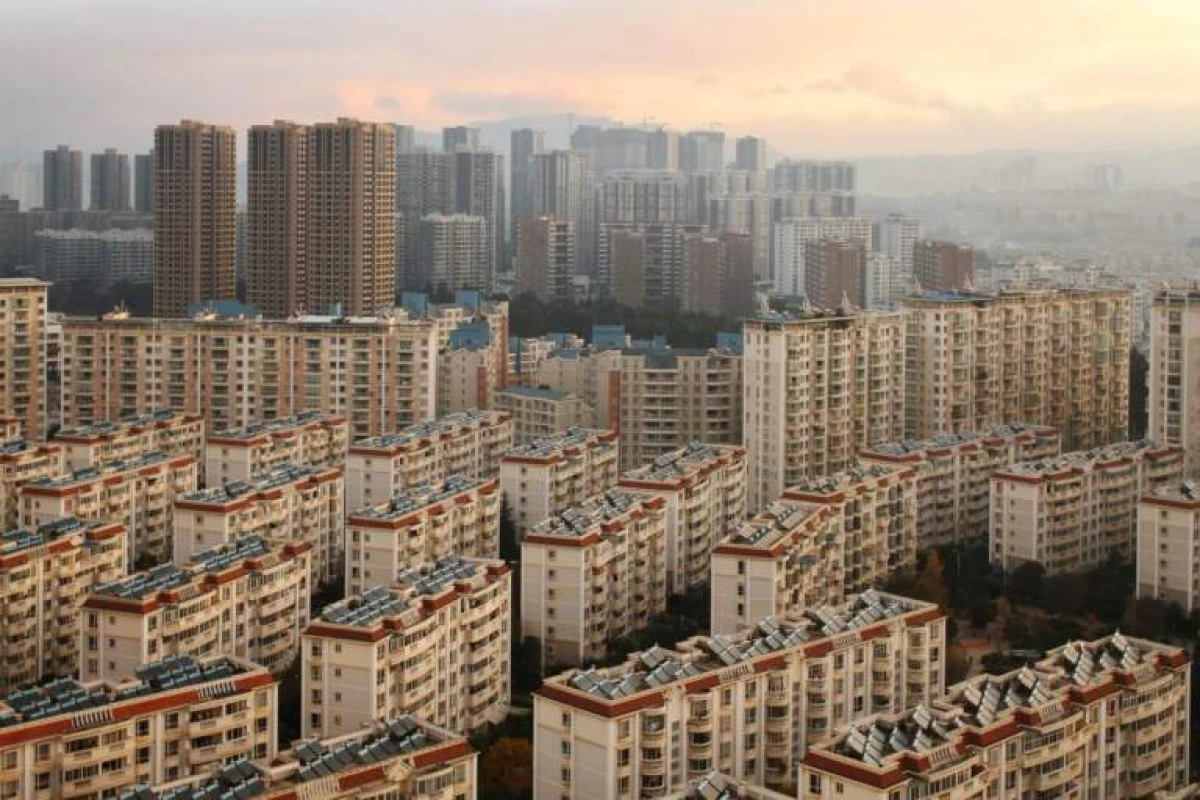
Oversupply is pressuring the market.
The prolonged downturn in the real estate market in China is becoming one of the main global macroeconomic problems. Amid continuing declines in housing investment, falling home prices across the country (see the chart below), and persistently weak consumer confidence, the question is increasingly being raised whether China risks repeating Japan's stagnation caused by the real estate market crash in the 1990s.
This turn of events has come as a complete surprise to many observers. Undoubtedly, some doubted the sustainability of the extraordinary rise in real estate prices in China and warned of the risks of a correction. However, for many years, the prevailing opinion was that a correction was still far off, and if it did occur, it would be significantly less destructive than Western real estate crises. The debt burden on Chinese homeowners is lower than, for example, that of Americans, and China's strong central government would be able to deal with defaults more quickly and effectively than Western legal systems, alleviating the prolonged uncertainty that makes debt crises so exhausting.
However, now, in the sixth year of the crisis in China, the notion that real estate downturns are usually mild and short-lived, unless exacerbated by shocks in the banking sector, seems exaggerated. Other mechanisms are also at play. For instance, one study demonstrated that building excessive amounts of housing can lead to prolonged demand shortages even without a classic financial crisis. As we have shown earlier, overbuilding in China has reached staggering proportions.
In our recent work, we compare the current correction in China's real estate market with the experience of Japan in the 1990s. We analyze relative growth rates in different cities (nearly 300 in China) and prefectures (47 in Japan). In both cases, regions with significant overbuilding experienced severe economic downturns. The comparison is not perfect, as China today is poorer, less financially liberalized, and operates under a different political system. Nevertheless, despite deep institutional differences, a striking similarity is found in the dynamics of investment and consumer sentiment.
Massive Investments Contributed to Rapid Urbanization
For decades, real estate has played a key role in China's economic miracle. Considering the links to previous and subsequent links in the production chain, as well as the accompanying infrastructure, the share of the real estate sector peaked at nearly one-third of GDP. Massive investments contributed to rapid urbanization and increased local government revenues through land sales.
However, it was precisely the scale that became a problem. By the end of the 2010s, housing per capita in China reached levels comparable to much wealthier economies. In many small and less diversified "third-tier" cities (referring to an unofficial hierarchy of economic development in Chinese cities), often experiencing population declines, construction continued despite falling demand. The returns on new investments were steadily decreasing.
In Japan during the 1980s, a remarkably similar dynamic was observed. Residential and commercial construction grew alongside infrastructure investments, leading to incredible increases in land and home prices. When the bubble burst in the early 1990s, real estate investment remained subdued for decades and never returned to pre-crisis levels.
The main lesson from both episodes: housing is highly durable, and excessive investments during an economic boom cannot be quickly compensated. As a result, oversupply continues to pressure the economy for a long time, limiting new investments and economic activity even after volumes and prices peak.
The Strength of This Effect is Particularly Noticeable When Comparing Cities
Using data from Chinese cities and Japanese prefectures, we identified a common pattern: regions that built more actively during the boom subsequently faced deeper and more prolonged downturns. In both countries, the contribution of real estate investment to economic growth declined over time and ultimately became negative.
Importantly, this decline began even before clear crisis events. In China, the returns on real estate investments began to fall long before the massive default of the developer Evergrande in 2021 and the tightening of the "three red lines" policy (three criteria for assessing the debt burden of developers in China), aimed at reducing the sector's debt load. The strength of this effect is particularly noticeable when comparing cities. This indicates that the downturn was caused not so much by regulatory errors as by accumulated structural imbalances.
Japan's experience shows how prolonged the negative impact of excessive real estate investment on economic growth can be. It persisted for more than a decade after the bubble burst. Even when GDP eventually stabilized in the late 1990s and early 2000s, the real estate sector continued to hold back the economic recovery.
This means that a simple stabilization of real estate prices or a recovery in lending is unlikely to quickly revive economic growth. When the problem lies in excess rather than a lack of capital, stimulus measures yield diminishing returns.
In Japan, Falling Land Prices Severely Worsened Household Balances
Aggregate investments, often exceeding baseline demand, gradually create oversupply and exert persistent pressure on prices, especially in cities with pronounced "overhangs" of investment. In both countries, falling home prices had a powerful impact on wealth. In Japan, falling land prices severely worsened household balances, and consumption sharply declined even where lending was unaffected.
In China, this mechanism operates even more strongly. Housing accounts for about 70% of the wealth of Chinese households, which is much higher than in developed countries, while consumption is only about 40% of GDP, significantly lower than in developed countries. When housing prices fall, households cut back on spending because they feel poorer, and also because housing serves as a savings vehicle "for a rainy day" in the context of limited social protection.
According to our estimates, a large-scale correction in housing prices in the country could reduce aggregate consumption by 2–4 percentage points of GDP, which is much more than the announced measures to support consumption can compensate.
The Vicious Circle Closes and Becomes Self-Sustaining
In addition to the impact on wealth, sentiment plays an important role. When households expect further price declines, they postpone purchases, increase savings for emergencies, and thereby exacerbate the slowdown in economic growth. This "paradox of thrift," described in earlier works on consumer sentiment, was also observed in Japan, where pessimism about land prices persisted long after the initial crash.
In the case of China, sentiment plays a particularly important role. Based on an analysis of the news background of the real estate market, we found that pessimistic sentiments significantly amplify the impact of falling prices on consumption. Once households stop perceiving housing as a reliable savings tool, the vicious circle closes and becomes self-sustaining.
Despite all these parallels, China is not Japan. The structure of debt obligations differs: in Japan, the crisis primarily affected private banks and corporations, while China's vulnerabilities are concentrated at the level of local governments and state-related organizations. Moreover, China has greater administrative capabilities to delay the recognition of losses and prevent a complete collapse of the financial sector.
China also has other advantages that Japan did not have. Productivity growth remains high, and the country is at the forefront of the global economy in several rapidly growing sectors, including electric vehicles, renewable energy, and more recently, artificial intelligence. These factors may help prevent a full-scale repetition of Japanese stagnation.
But the differences work both ways. China is aging faster than Japan did in the 1990s, and still being a developing country, it does not have as extensive a social safety net as Japan. Furthermore, new growth drivers, no matter how dynamic they may be, are still too small compared to the real estate market. A rapid transition from one export-oriented boom to another is unlikely to fully compensate for the lack of domestic demand in an economy the size of China's.
The main lesson to be drawn from the experiences of Japan and now China is that it is not enough to avoid a banking crisis. When an economic growth model built on investment, whether in real estate, infrastructure, or emerging sectors, faces diminishing returns, the adjustment can be long and difficult even without a full-blown banking crisis, unless demand can be redirected in favor of consumption.
From this analysis, several key patterns emerge. Accelerating the reduction of excess housing supply, even at the cost of recognizing losses, may shorten the adjustment period. Prolonged inaction can lead to the "zombification" of local governments and developers, similar to how zombie banks in Japan held back its economy for decades. At the same time, restoring household confidence requires more than just stabilizing prices. A more developed social safety net, clear income prospects, and credible policies aimed at balancing the economy can help reduce excess savings and revive consumption.
Japan's "lost decades" serve as a warning. China still has the opportunity to influence the outcome of its adjustment, but this window of opportunity is narrowing as excess production capacity, weak consumption, and negative expectations reinforce each other. The real estate sector may no longer be a driver of economic growth, but how China manages this will determine the country's macroeconomic trajectory for years to come.