
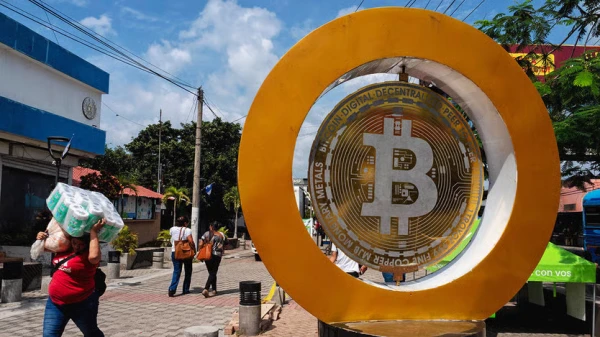
President Bukele is obsessed with digital currency.
El Salvador's experiment with bitcoin, which was supposed to turn the country into a global center of the crypto economy, is increasingly raising questions. The decline in the cryptocurrency's value, the risk of damaging relations with the IMF, and rising financial costs cast doubt on the strategy of President Nayib Bukele, who made digital assets one of the country's main economic projects. Bloomberg Opinion columnist Juan Pablo Spinetto explains why Bukele should not have staked the country's economy on cryptocurrency.
El Salvador's future was painted as a utopia: the transition to bitcoin was supposed to transform the country into a tech-libertarian paradise — making banking services accessible to those who previously had none, attracting innovators from around the world, and finding funds for futuristic projects, from a national digital wallet to "smart" cities and so-called "volcanic bonds." These are government bonds totaling $1 billion, part of which was planned to be invested in bitcoin, while another part was to be directed towards the development of mining and infrastructure using geothermal energy from volcanoes.
This is the grand vision that Nayib Bukele painted when El Salvador became the first country in the world to recognize cryptocurrency as legal tender in 2021. However, five years later, most of the promised benefits have yet to materialize, while costs — both financial and reputational — continue to rise. The drop in bitcoin's price, which is now worth about half of its October peak, clearly demonstrated how risky a bet the tech-savvy millennial president, enamored with cryptocurrencies, has made.
The problem is not limited to the unrealized losses of recent months. By doubling down and spending over $100 million on new tokens in November — even before the most active market sell-off began — Bukele jeopardized cooperation with the International Monetary Fund. A $1.4 billion program was approved last year, and the agreement explicitly stipulated that the government must maintain the total amount of bitcoins on its balance sheet unchanged. Therefore, the decision to continue purchases — including his usual practice of acquiring one bitcoin a day — appears, to put it mildly, extremely irresponsible.
IMF programs typically falter when strict budget austerity provokes strong political resistance, the economy slips into recession, or an external shock triggers a balance of payments crisis. In the case of El Salvador, none of this is happening. On the contrary, the dollarized economy of the country has managed to achieve certain successes in reducing the budget deficit and restoring international reserves.
In 2025, El Salvador finished with an economic growth of about 4%, and the forecast for the current year remains favorable. This supports investor confidence and is reflected in the country's sovereign bond prices.
Moreover, the government has met several IMF requirements aimed at reducing the country's dependence on cryptocurrencies. When El Salvador introduced bitcoin as legal tender in 2021, businesses were required to accept it as payment — just like regular money. Recent amendments to the law have made the acceptance of cryptocurrencies voluntary. Additionally, authorities have begun looking for a buyer for the state crypto wallet Chivo — a mobile application created by the government for storing bitcoins, making payments, and exchanging cryptocurrency for dollars. Thus, in accordance with IMF requirements, the state's involvement in cryptocurrency operations has been reduced.
However, the main problem lies elsewhere: Bukele simply cannot stop buying bitcoin — as if it were a personal addiction. The record deal in November, when nearly 1,100 coins were purchased at a price above $90,000 per bitcoin, turned out to be particularly unfortunate.
The price of bitcoin is around $68,000. At this price, the 7,580 coins on the government's balance sheet were valued at approximately $515 million — while at their peak, their value approached $800 million.
Assessing the long-term effectiveness of this strategy is more complicated, but it likely remains profitable. According to ChatGPT's estimates, based on published data on past transactions and recent purchases, the average acquisition price of bitcoin for El Salvador is about $53,000 per coin. This means that the country's total spending on cryptocurrency purchases could be around $400 million, which at the current exchange rate corresponds to a yield of about 28%.
However, that is not the point. If the country's financial reputation depended on how successful a trader Bukele turns out to be, El Salvador would hardly have sought support from the IMF at all. But since this has happened, the government should adhere to its commitments: sell a significant portion of the tokens as a goodwill gesture and resume negotiations on the delayed second review of the program while preparing for the third. Equally important is the decisive advancement of pension reform.
However, Bukele seems to be betting that the market will rise again and save him — as has happened before. If not, he may try to secure financial support from his ally — U.S. President Donald Trump, considering his administration's softer stance towards ideological allies in Latin America. None of these scenarios appear simple or particularly rational compared to the most obvious solution. However, in authoritarian systems, politics is often determined by the instincts of an unpredictable leader surrounded by a compliant entourage.
In a sense, his motivation is understandable. For someone who has been promoting bitcoin since at least 2017 and has already invested enormous political capital in this project, admitting a mistake now would mean acknowledging that he made a wrong bet. However, in the current price crash, he should see something more than ordinary market volatility. If bitcoin cannot serve as a protective asset for a fully dollarized economy like El Salvador's, even during a cyclical weakening of the dollar, then what is its purpose? Perhaps it would be wiser for Bukele to tie his fate to gold.
But there is a more troubling question: what will this experiment mean for the country and its economic program if the promised value of cryptocurrency ultimately turns out to be an illusion, as some experts warn? In this case, the risks are clearly uneven.
Despite talk of turning El Salvador into an oasis of personal freedom and independence from the "tyranny of central banks," the reality looks much more prosaic. The country's economy, worth about $37 billion, is increasingly dependent on remittances from abroad.
The volume of funds sent home by Salvadorans living mainly in the U.S. grew by 18% last year and now accounts for about a quarter of the country's gross domestic product.
And despite Bukele's digital obsession, real results are coming from the traditional economy. Tourism and construction are growing in the country — largely thanks to a large-scale campaign by the authorities to combat crime, which has also increased consumer confidence.
This is the path that may one day bring El Salvador closer to the status of the "Singapore of Latin America," rather than the increasingly outdated cryptocurrency dream.
With only a year left until the presidential elections, a failure of the cooperation program with the IMF could undermine one of the key pillars of the country's economy. Salvadorans can only hope that their president realizes the real cost of his bitcoin fantasy before that happens.









Leave a comment