
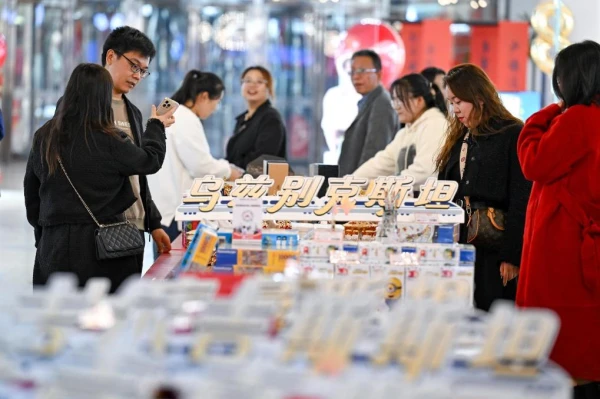
Along with traditional resources, supplies of non-raw materials are increasing.
In 2025, trade between China and Central Asia (CA) surpassed the $100 billion mark for the first time, increasing by 12% compared to the growth in 2024. At the same time, China became the largest trading partner of all CA countries for the first time. In a context where global economic growth remains sluggish and the international trading system has suffered a serious blow, this achievement not only sets a new historical record but also demonstrates new opportunities for cooperation that the super-market of China offers to CA countries.
At a video summit marking the 30th anniversary of diplomatic relations between China and the five CA countries, Chinese President Xi Jinping stated, "China is ready to open its super-market to CA countries, increase imports of high-quality goods and agricultural products from the region, continue to hold the China-CA trade and economic cooperation forum, and strive for bilateral trade to reach $70 billion by 2030."
Chinese Foreign Minister Wang Yi stated that during the 15th Five-Year Plan (2026-2030), China will carry out more effective and substantive cooperation with CA countries. According to him, Beijing intends to follow the path of modernization together with Central Asian countries, "opening new horizons in promoting high-quality cooperation," and jointly forming a "community with a shared future."
As stated by Wang Zhihua, director of the Department of Foreign Trade of the Ministry of Commerce of China, China aims not only to be the "world's factory" but also to become the "world's market." Its hyper-scale market will open broader opportunities for products and services from all countries. This commitment is currently being translated into specific policy measures.
Today, high-quality agricultural products from CA, including honey, fruits, and wheat, are steadily supplied to Chinese supermarkets and e-commerce platforms. Over 100 types of agricultural and food products have been officially approved for supply to China, and more than 4,000 enterprises from CA countries have gained access to the Chinese market. In 2025, China's imports from Central Asian countries reached $35.1 billion, increasing by 14% compared to the previous year. Along with traditional resources, supplies of non-raw materials such as chemical products, metallurgical products, and agricultural goods are increasing, contributing to a more balanced and diversified trade structure.
The convincing results of China's interaction with CA countries are particularly evident in the fact that the new "trio" of Chinese exports - new energy vehicles, lithium batteries, and photovoltaic products - is gaining increasing popularity in the region's markets. Significant growth is demonstrated in the supplies of machinery, electronics, and high-tech products, contributing to the modernization of infrastructure and the energy transition throughout the region.
In Uzbekistan, the application of Chinese drip irrigation technology on cotton plantations has significantly increased yield and water-saving efficiency. In Kyrgyzstan, a factory for the production of organic agricultural fertilizers, established in collaboration with Chinese enterprises, has achieved a breakthrough in local production of complex fertilizers, and now the products are exported to neighboring countries.
Thanks to mature cross-border e-commerce and logistics systems in China, small and medium-sized enterprises in CA gain access to Chinese consumers with fewer barriers.














Leave a comment