
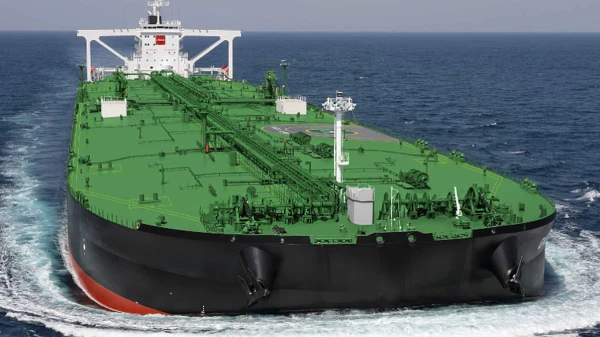
Maritime routes for hydrocarbons may become less profitable.
As Russia attempts to redirect its Urals oil to China after India cut its imports, it requires larger tankers due to the longer route. This would help reduce costs if not for one "but": the freight rates for supertankers have skyrocketed sevenfold in less than two months. Additionally, due to the inability to quickly sell the exported raw materials, Russia has to store increasingly larger volumes at sea, and the high costs of tankers are also undermining the economics of sales.
Such prices have not been seen since the beginning of the coronavirus pandemic, when a price war between Russia and OPEC led to massive volumes of oil being stranded on maritime routes without demand, Bloomberg notes. The daily rental rate for supertankers (VLCC) on the benchmark route from the Middle East to China exceeded $200,000 – 600% higher than at the beginning of the year when it was less than $29,000.
This affects even those exporters who are not under sanctions. The further they are from the market, the more significant discounts they have to offer, Bloomberg points out. Meanwhile, Russia has been actively transshipping oil at sea onto supertankers in recent months to deliver it to China instead of India, as it did before. According to Vortexa and Kpler, since December, approximately 6.3–6.9 million barrels of Urals oil have been delivered on smaller tankers from western Russian ports through the Suez Canal to the Red Sea. There, they were transshipped onto four supertankers.
This area is not a traditional place for ship-to-ship oil transshipment, Bloomberg notes. Its use may be explained by the fact that Western countries have become more vigilant about popular transshipment locations – for example, north of the Suez Canal, as well as near Greece or Malta. Another traditional location near Oman has become less convenient due to hostilities in the Persian Gulf and its vicinity.
Such actions indicate a growing dependence of Urals suppliers on China, said Anna Zhminko, an analyst at Vortexa.
Among the supertankers tracked by Vortexa and Kpler was the Sahara, which is under U.S. sanctions. Near the Sinai Peninsula close to Egypt, it took on 1.7 million barrels of oil from several Suezmax and Aframax tankers that came from Novorossiysk. It subsequently transshipped this oil in the Far East, near Nakhodka, onto other smaller tankers that delivered the raw materials to China.
The entire operation took about three months, whereas delivery by the usual route to India typically took 5–6 weeks. This also increases costs, reducing revenues from oil exports.












Leave a comment