
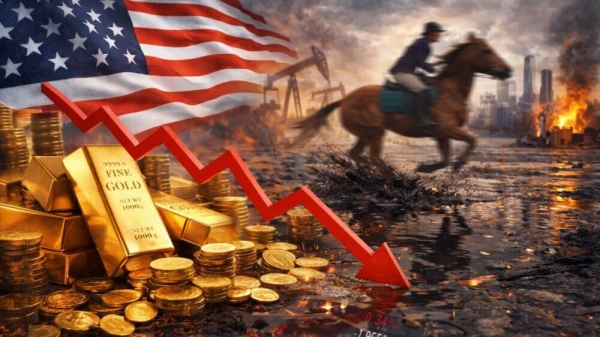
All quotes are influenced by Washington's politics.
In the Year of the Red Fire Horse, some people may be tempted to bet on investments in precious metals — gold and silver, rather than the US dollar, based on January trends. On January 28, the price of gold reached $5,344.30, up 23% from $4,345.80 — the value on December 31, 2025. Silver rose from $72.17 on the same date by 63% to $114.98 by January 29, 2026.
However, only one month of 2026 has passed, and the race is still long — so hold your horses and think about the long-term consequences. Take the February lesson, as prices stabilized closer to the values of late 2025: in February, gold was priced at $4,974.40, and silver at $77.00.
Before understanding how changes in variables affect the prices of world currencies and the precious metals market, we must first understand how this equation works. Unlike national currencies — the dollar, euro, or yen, whose rates fluctuate based on geopolitical decisions, inflation, and economic policies, precious metals, especially gold and silver, are relatively stable. They are worthy investments for protection against economic, political, and external uncertainties, as regardless of what happens with current events, precious metals always exist as a safe alternative commodity. That is, as currencies lose value, they become more worthy investments — which can be offset by including gold and silver in your portfolio; currencies and precious metals have an inverse correlation. Now that we understand how the formula works, let’s take a closer look at three specific variables and how their changes affect the equation.
The first variable, foreign policy, most significantly influences decision-making and even the rhetoric of American President Donald Trump, critically impacting the inverse correlation between the US dollar and precious metals. Trump’s actions and rhetoric in foreign policy, especially before the mid-January conference in Davos, were particularly aggressive, alarming leaders, investors, and economists both domestically and abroad. Trump arrested and overthrew Venezuelan President Nicolás Maduro, nationalizes and sells Venezuelan oil, threatens military action against the current leadership of Iran, aggressively and hostilely seeks American annexation of Greenland, and publicly threatens the governments of Cuba, Colombia, Mexico, and Canada. He has revived the application of the "Monroe Doctrine," which states that European colonization is unacceptable in the Western Hemisphere. And although the speech primarily concerns America, Trump asserts that it also applies to Greenland. This already means that any intervention in this arena by European states will be regarded as a "hostile act."
Recall that President Trump has already taken actions regarding Venezuela, amassed military resources towards Iran, and refused to rule out the possibility of military action for the forcible acquisition of Greenland. His words, even if they sound like a joke, have serious consequences. Too many people have taken his rhetoric at face value, anticipating upheavals in foreign policy. As a result, the key variable contributed to the decline of the US dollar in January, leading to a compensatory spike in the value of gold and silver.
The second key variable is economic policy, and here Trump also leaves his mark with his rhetoric. After several NATO European allies, including Denmark, Germany, France, and the United Kingdom, sent troops to Greenland as a show of force and publicly opposed the American annexation of Greenland, the US President threatened these countries with the introduction of tariffs starting in February. This, in addition to threats of increased tariffs for states that continue to purchase Russian oil, including the most populous countries in the world, which collectively export products worth over $600 billion to the United States, China, and India, the main consumers of discounted Russian gasoline. Moreover, President Trump articulates his main role in selecting a new Federal Reserve Chair who would support his desire to lower interest rates. Typically, when inflation rises, the Federal Reserve raises interest rates to stimulate savings; a unilateral demand for the Federal Reserve to lower interest rates could lead to inflation exceeding its normal level. Consequently, unfavorable economic conditions weaken the dollar, increasing the cost of precious metals.
Finally, the third variable is the actions of central banks in several countries. Given the recent actions of the US government, including withdrawal from international treaties, such as the Paris Agreement, and becoming an increasingly unpredictable NATO ally, several developing countries are trying to reduce their excessive dependence on the US dollar. The central banks of China, Turkey, and Serbia are just a few of those buying up gold bullion and alternative silver products. This leads to rising prices according to the basic rule of economics — the relationship between supply and demand. Of course, the supplies of gold and silver remain the same, but as governments and other stakeholders seek to acquire precious metals for protection against the US dollar and, especially, to reduce dependence on it, prices naturally rise.
So, considering the influence of these three variables, we now understand why the prices of gold and silver reached record highs at the end of January 2026. So why did they fall in February? The answer is simple: since then, two of our three variables have stabilized at levels that existed before 2026. At the Davos conference in mid-January, President Trump promised that military force is not being considered in the acquisition of Greenland, and also eliminated the threat of tariffs for NATO European countries that sent troops to Greenland. Additionally, India recently promised to stop purchasing Russian oil and instead switch to Venezuelan oil, so he also canceled the corresponding tariffs. Instead of attacking Iran, President Trump is now conducting nuclear negotiations with its leadership. As for the Federal Reserve, President Trump appointed Kevin Warsh, a member of the Federal Reserve Board, as the head of the Federal Reserve System, who is considered a relatively traditional, experienced, and reliable candidate. Thus, only the third variable, the purchase of gold and silver by the central banks of developing countries, remains at the same level, which explains why the prices of gold and silver today are still slightly higher than at the end of 2025 — but significantly lower than in January.
Let’s hope that President Trump now better understands and realizes how his actions, threats, and even jokes impact the international economy. He has established himself as a temperamental leader, often acting on emotions — and logic and consideration of consequences often come to him later. The fact that he has taken steps to de-escalate various situations is a hopeful sign; at least the president or his advisors understand and recognize the long-term consequences of their actions.
All of this may change again. The United States may still undertake a sudden attack on Iran. Or apply military force for the hostile annexation of Greenland. Or initiate a new round of tariffs that then will not be canceled. However, for now, both the US dollar and precious metals are in a more favorable position than usual. So if you win a gold or silver medal at the Olympics, cherish it, display it, keep it as a souvenir and trophy. One day it may become so valuable that you will have to sell it — but, as we say to the god of death in "Game of Thrones": "Not today!"













Leave a comment