
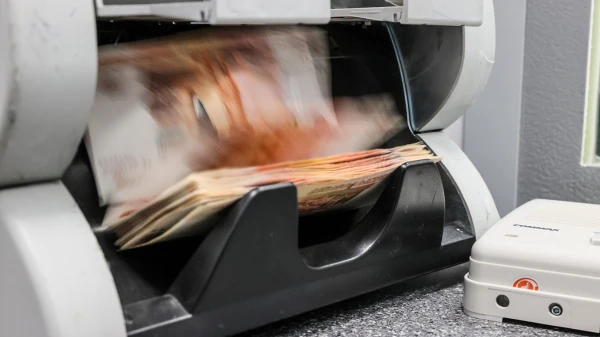
Authorities have also begun mass blocking of transfers from account to account due to the fight against fraud.
Russian authorities have begun discussing the possibility of limiting cash withdrawals for Russians at bank counters. This proposal was made by Deputy Minister of Internal Affairs Andrey Khrapov as part of the fight against fraud, as reported by Kommersant. At the Cybersecurity forum, he stated that bank clients could be allowed to withdraw no more than 50,000 rubles and that a 'cooling-off' period could be introduced if there is suspicion that they are under the influence of fraudsters.
Bank representatives supported this idea. According to Sergey Veligodsky, the director of the fraud prevention department at Sberbank, if a fraudster has seriously groomed a victim, they can withdraw all their money from bank accounts, as there are currently no restrictions. Meanwhile, Vadim Uvarov, the director of the information security department at the Central Bank, noted that this idea has been discussed for several years, but criteria for definitively determining whether a person is acting in the interests of fraudsters have yet to be formalized. Uvarov also described the topic as 'very sensitive.'
The introduction of a cooling-off period for cash withdrawals at bank counters is a logical continuation of the restrictions on ATM withdrawals, said Andrey Emelin, head of the National Financial Market Council (NSFR). 'Introducing a withdrawal limit is a more controversial issue, as it ultimately deprives a citizen of the right to dispose of their own funds,' he added.
The bank cannot replace the court and law enforcement agencies, conduct independent investigations, or make judicial decisions, noted independent financial expert Alexey Voylukov. 'This is a strange way to combat fraud; thus, the value and cost of cash will only increase in the market, and essentially we will have different values for the ruble depending on its form,' the expert explained.
Earlier, Russians began facing restrictions on cash withdrawals at ATMs as part of the fight against fraud. The corresponding law was passed in the spring of 2025. Later, the Central Bank identified nine signs that credit organizations use to detect suspicious transactions. These include unusual times of day for cash withdrawals, atypical amounts or locations of ATMs, as well as requests for cash withdrawals that are uncharacteristic for the client — for example, not from a card but via QR code. A transfer of more than 200,000 rubles via the SBP between one's own accounts or an early closure of a deposit for a similar amount is also considered suspicious.
Additionally, Russians have been facing mass blocking of transfers from account to account due to the fight against fraud. Among the criteria for suspicious transactions are making a transfer at an atypical time for the client, an unusual amount, a suspicious device, and a recipient who has been identified in fraudulent schemes. Furthermore, a transaction may be restricted if money is transferred to a person who has not had any transactions in the last six months, provided that a large transfer of 200,000 rubles or more was made to oneself beforehand.














Leave a comment