
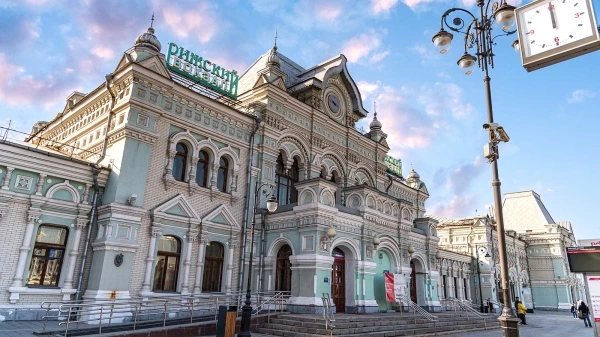
Here, the clock played the melody of Raimonds Pauls.
Anastasia Kotkovskaya, the first deputy head of the corporate property department of Russian Railways, announced during the conference "Corporate Property of Russian Railways: A Resource for Urban Development" that the starting price for the Riga Station in Moscow at the auction will be 4 billion rubles, including VAT. (44,304,982.21 EUR).
The construction of the Riga Station began under the highest decree of Emperor Nicholas II on March 2, 1897. The site chosen for its construction was the Krestovskaya Zastava in Moscow. At that time, there were only two water towers located here. The city administration imposed three conditions on the "Moscow-Vindava-Rybinsk Railway Company," which was responsible for the construction. The organization was required to improve the nearby streets and take care of the condition of the Moskva River water supply. Additionally, the new building had to harmonize with the water towers.
The grand opening of the facility took place on September 11, 1901. Initially, the station was called Vindava Station, named after the Moscow-Vindava railway. The new transport hub connected the capital with the ice-free seas of the Baltic.
The architect of the project was Stanislav Brzhozovsky, and the construction was overseen by Yuli Diderikhs, with his assistant being Foma Bogdanovich-Dvorzhetsky. It was decided to execute the station in the popular neo-Russian style of the time, imitating the buildings of the 16th and 17th centuries. As a result, it was designed in the form of three two-story "terems." They were connected by single-story walkways.
The building itself was adorned with window frames, kokoshniks, runners, and a covered porch reminiscent of boyar chambers. All elements were successfully balanced.
Despite its ancient appearance, the station was one of the most technically equipped in Moscow. Its internal and external lighting was provided by its own autonomous power station. Metal canopies were installed over the platforms, protecting passengers from snow. The building was located parallel to the railway tracks.
After the Opening
The station was divided into two stations: passenger and freight. They were called Moscow-Passenger Baltic and Moscow-Freight Baltic. The station became one of the busiest in Moscow. It allowed travel not only to the Baltic states but also to Poland and Belarus.
The station's popularity significantly declined during World War I. The export of goods from the port of Vindava ceased as the German fleet blocked the Baltic. In 1915, Kaiser’s troops captured part of the Baltic states, including Vindava. Refugees headed to Moscow by train.
Soviet Years
After the revolution, the country lost the Baltic states, and the Moscow-Vindava line lost its significance. In the 1920s and 1930s, passenger and freight traffic through the Vindava station was low. Suburban trains ran from the station to Volokolamsk. In 1930, the station was renamed Baltic, and in the mid-1930s, it was renamed Rzhevsky.
In 1940, the Baltic states were annexed to the USSR, and the official status of Estonia, Lithuania, and Latvia in the Soviet Union was established in 1945. A second life began for the station. In 1948, it was renamed Riga. The volume of train traffic began to increase, and by 1984, the station was receiving and dispatching six pairs of long-distance trains, as well as dozens of suburban electric trains. For Soviet citizens, the new republics became their own "abroad." In the 1970s, the iron canopy over the tracks was dismantled.
In Modern Russia
The Soviet Union collapsed in 1991, and Estonia, Lithuania, and Latvia became independent states, while new tourist destinations opened beyond the country. The popularity of the Riga Station began to decline again. In 1995, a partial reconstruction of the facility was carried out. At the end of the 20th century, the construction of the Third Transport Ring began in the capital. It affected the territory of the Riga Station, with the freight yard, storage rooms, and other auxiliary premises being partially demolished. However, the main building was not affected by the construction.
In the early 2000s, there were proposals to close the station along with Savelovsky due to low traffic, and to eliminate the underground tracks. These plans were ultimately not realized. Gradually, the station became popular again among people traveling between Russia and Latvia. Additionally, suburban electric trains to Volokolamsk, Shakhovskaya, Pavshino, Dedovsk, Nakhabino, Novoiyerusalimskaya, and Rumiantsevo departed from here.
In 2001, new clocks were installed above the main entrance of the station. At the beginning of each hour, they played the first two lines of the chorus from Raimonds Pauls' song "Vernissage."
In 2007, a major renovation of the station was carried out. As part of the reconstruction, the load-bearing structures were reinforced, and the facades were tidied up. Historical decorative elements were preserved during this process. In the same year, an exhibition complex "Russian Railways" was opened on the station's territory. Here, visitors can see historical models and exhibits telling the story of railway transport in Russia. There is also a children's center "Russian Railways" on the station's premises. In 2023–2024, the station was renovated again. New platforms, updated long-distance ticket offices, a medical point, and sanitary rooms were added. Canopies were installed along the entire length of the platforms, and benches were placed, along with energy-efficient lighting. Currently, the station is used only for suburban services.
A Cinematic Hero
The Riga Station has been featured multiple times in films. Scenes were shot there for "Ballad of a Soldier" (1959), "The Tavern on Pyatnitskaya" (1978), "A Station for Two" (1982), "We Are from Jazz" (1983), "Brigada" (2002), and "Admiral" (2008).
The Riga Station appeared twice in "Seventeen Moments of Spring." It "played" two foreign stations: first a German border station, and then the Bern station. From there, Stirlitz saw off the radio operator Kat.








Leave a comment