
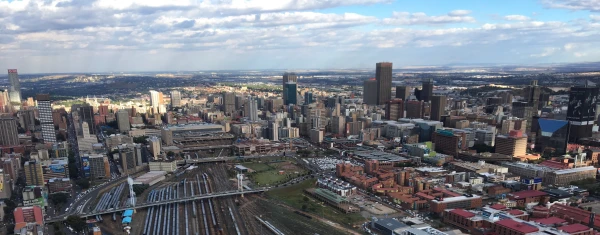
In 2027, the African National Congress will elect a new leader.
For an entire decade, South Africa experienced economic stagnation. Its revenues fell, and its positions in the global economy were almost completely lost. But today, more and more signs are emerging that this sad paradigm is changing: the current coalition government is promoting cautious market reforms, and macroeconomic indicators have finally started to rise, as reported by The Economist. Are these shifts enough to turn fragile optimism into sustainable growth?
The economy of South Africa has long been associated with major failures. The wealth of its diamond and gold mines in the 20th century helped the country become the most industrialized in Africa. However, in recent years, the economy has fallen into a deep hole. GDP per capita today is lower than it was 20 years ago. During this time, South Africa has dropped from 27th to 39th place among the world's largest economies, losing ground to countries like Bangladesh, Thailand, and Israel. In September, one sociological survey showed that 80% of South Africans believe the country is heading in the wrong direction.
However, the number of optimists is growing against this backdrop. Adrian Enthoven, head of the investment company Yellowwoods and a representative of a well-known business dynasty, expressed their common sentiment at the end of last year, stating that "after a decade of decline, South Africa has turned a corner." If he is right, the changes will be significant not only for the country itself but for the entire continent, considering that South Africa remains the largest economy in Africa. Thus, President Ramaphosa, whose term is nearing its end, will receive a completely different assessment for his actions.
The arguments of the optimists primarily concern state-owned companies, such as the power utility Eskom. In 2022, economists from Harvard University calculated that since 2008, South Africa's lag behind other economies in 40% of cases was related to the failure of public utilities. Like other state structures, they were effectively looted during the presidency of Jacob Zuma, Ramaphosa's predecessor.
With the arrival of new and more competent managers at Eskom, the number of days without electricity has decreased from 284 in 2023 to just 8 last year. The widespread adoption of solar panels on rooftops has also played a role.
According to Enthoven, improvements in South Africa's economy are not limited to successful management of individual state-owned companies but have a systemic nature. He believes that since 2020, after the launch of Operation Vulindlela (a government working group created with strong business support), President Cyril Ramaphosa has consistently promoted market reforms that remain undervalued. These changes received an additional boost in 2024 when a Government of National Unity was formed—a coalition of the African National Congress and the Democratic Alliance.
State monopolies are gradually opening up to competition. For 100 years, Eskom controlled the production, transmission, and distribution of electricity. But since 2023, power plants of any size can be built without a license. The establishment of an independent electricity transmission company means that electricity will soon be sold on the open market. These changes have triggered an investment boom. Developers are considering renewable energy and energy storage projects that are approximately four times the installed capacity of Eskom (although not all will be realized).
Transnet, the state company that for many years could not increase exports due to poor management of ports and freight railways, is following a similar path. In December, it signed its first privatization deal for a port, granting a 25-year concession to a Philippine company to manage the Durban port—the largest in sub-Saharan Africa. Soon, about 11 private rail operators will gain access to previously monopolized Transnet routes, which transport minerals from mines to ports.
There is more good news. Auctions for radio frequency sales have helped improve mobile coverage and reduce data transmission costs. Delays in issuing work visas, which had long irritated businesses, have mostly been eliminated.
After amendments to the Public Service Amendment Bill, the civil service, which for many years has been filled with party cadres of the African National Congress (the ruling party of South Africa, which systematically appointed loyalists to key positions regardless of their professional competence), is expected to become more professional and politically neutral. After all, it was the practice of party appointments that hindered the normal functioning of the state, weakened the management of state-owned companies, and created favorable conditions for corruption. According to Enthoven, abandoning this practice could become the most important institutional reform in the lives of South Africans.
The macroeconomic situation in the country has also begun to improve, as evidenced by several key indicators. In 2025, South Africa completed the year for the first time in 15 years not with a deficit but with a budget surplus, which has been maintained for two consecutive years.
Against this backdrop, the ratio of public debt to GDP—one of the main indicators of financial stability—may soon begin to decline, meaning that the debt burden will stop growing. Inflation in 2025 fell to its lowest average level in 21 years.
An additional signal of recovery was the decision by the rating agency Standard & Poor’s: in November, it raised South Africa's sovereign credit rating for the first time in nearly two decades, which always enhances the country's attractiveness in the eyes of investors.
Yet, the growth rates capable of significantly reducing unemployment are still far off. The unemployment rate in South Africa remains one of the highest in the world: it currently stands at 32%. Business leaders and members of Ramaphosa's government often talk about economic growth of at least 3% over the next three years, but the IMF believes it will not exceed 2% in the next five years.
The reason is that Ramaphosa has too limited a resource for implementing reforms. Rudi Dix, one of the leaders of Operation Vulindlela, acknowledges that despite "phenomenal" work, some processes are progressing too slowly. Even the internal audit of the group notes that progress on many of the five key areas (electricity, logistics, visas, water supply, and telecommunications) is "delayed or not on track."
Moreover, many critically important issues remain unresolved. Although power outages are becoming less frequent, the main complaint of people remains organized crime and its connections with political elites.
Economist Goolam Ballim from Standard Bank notes that while the basic conditions for economic growth in South Africa are gradually improving (primarily in energy and infrastructure), this is insufficient without serious changes in governance and law enforcement. According to him, the key problem remains the "Mexicanization" of South Africa, meaning the connections between organized crime and political elites. Currently, there is an investigation into allegations against several politicians, including former police minister Senzo Mchunu, who is suspected of ties to criminal organizations (he denies the allegations).
Ballim believes that this investigation gives South Africa a rare opportunity to strengthen the rule of law—similar to Brazil, where anti-corruption investigations under Operation Car Wash (Lava Jato) first touched high-ranking officials and big business. Without such a cleansing of the system, he emphasizes, even the most correct economic reforms will not yield sustainable results.
But even if these crises can be overcome, many factors still hinder growth. While some leaders, including black executives like Fani Titi from Investec, call for a review of the Black Economic Empowerment (BEE) policy, the African National Congress is unlikely to abandon its discriminatory programs, even though this only increases costs for businesses and serves as a cover for corruption. Many companies, especially in the mining sector, are concerned about the weakening of property rights protections.
Finally, politics. In 2027, the African National Congress, which has controlled power in the country since 1994, will elect a new leader. Typically, the head of the party then assumes the presidency, so this decision will be crucial for the country's future course. The main contender is the current Vice President Paul Mashatile, whose views on economic policy and coalition governance may differ from Cyril Ramaphosa's course.
The Government of National Unity formed in 2024, in which the African National Congress first shared power with the former opposition, has become an important factor supporting market reforms and a signal of stability for investors.
However, the collapse of the Government of National Unity and the rise of a populist coalition could be "catastrophic" for South Africa, notes Enthoven. Therefore, reform supporters need to act decisively and strengthen the existing political configuration. If South Africa truly intends to "turn the corner," it should hurry.









Leave a comment