
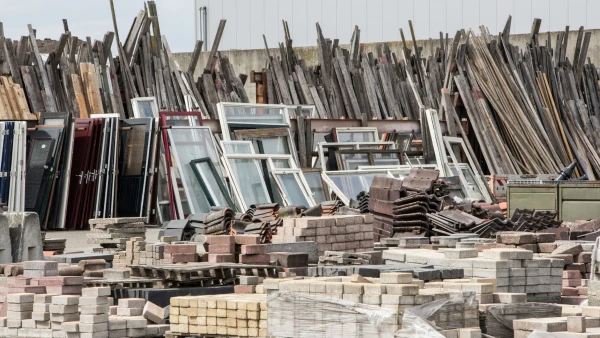
In recent months, there has been an increasing discussion in Latvia about the shortage of construction materials, which has led to a growing need to crush and add reused concrete, asphalt, and other materials to construction mixtures, said Maris Baltrums, a board member of SIA "Ekobaze Latvia."
These discussions are not unfounded: the delivery of gravel from the quarry to Riga costs about 20 euros per cubic meter. The purchase of crushed concrete gravel from construction material recyclers costs around 8.50 euros per cubic meter.
The same applies to sand, which is used to fill various voids and unevenness: new sand from the quarry costs about five euros per cubic meter, while secondary sand, obtained by crushing construction materials, costs about 50 cents per cubic meter. It is not surprising that construction waste recyclers are unable to meet the demand for reused construction materials, and all the produced gravel and sand are literally "snatched from their hands."
One might wonder why not completely switch to reused construction materials. Unfortunately, we face a problem here: the volumes of reused crushed construction materials entirely depend on the amount of construction waste coming from builders.
Moreover, it should be noted that there is competition for construction waste among recyclers, and near state borders, there is even international competition among the Baltic countries. Another limitation in using secondary construction materials is the high level of energy consumption required for their crushing and grinding.
However, there are also several positive factors that may improve the situation in the future and allow for the recycling of larger volumes of construction waste into reused materials.
The first of these is the increasing tax on natural resources: the higher it is, the more builders have to pay for the burial of construction waste in landfills, and consequently, the greater the motivation to recycle it. The burial of construction waste in landfills has been economically unfeasible for at least the last ten years, and with the increase in the tax on natural resources in the future, it will become even less profitable. Accordingly, it is increasingly rational to recycle construction waste or reuse it — for example, in the case of individual panels of building ceilings, of course, after conducting the necessary checks.
The second factor promoting the recycling of construction materials is the requirements of the European Union. They stipulate that member states must achieve a situation where 70% of construction waste is recycled and reused. These requirements will become increasingly stringent, providing for the sorting of construction waste during the demolition of buildings, separating potentially hazardous materials such as asbestos and paints from safe ones. The tightening of requirements in this area ensures that only suitable materials are recycled and also contributes to the growth of trust in secondary construction materials and their quality.
Latvia may already be achieving and even exceeding the mentioned threshold of 70% recycling of construction waste; however, unfortunately, part of this volume consists of low-quality material. Therefore, it is still very premature to say that we have fully realized the potential of a circular economy in this area. A more accurate assessment of the situation is hindered by the Latvian statistical system, which lacks data on what share of construction waste is recycled and reused.
Some unofficial sources cite a figure of 91%, but this is unofficial data. In any case, national statistics in Latvia in this area are not sufficiently transparent and detailed and cannot provide a complete picture of what share of construction waste we recycle. This is a problem that needs to be addressed in the future to ensure higher quality data.
It should be added that only "Ekobaze Latvia" accepted more than 452,700 tons of construction waste in 2024, and this is just one of a number of companies operating in this field.






Leave a comment