"Scenario planning" does not imply real work.
The German government and the Bundeswehr command have not begun the creation of camps for prisoners of war and have not announced the establishment of such facilities. There are no official statements or decisions from the German authorities indicating that the country allegedly plans to mass accommodate Russian prisoners of war in special camps on its territory. Claims about this are based on out-of-context remarks made by the head of the Hamburg Territorial Command, Kurt Leonards, and a manipulative interpretation of his speech at a defense symposium.
On social media and pro-Russian resources, there is a claim that at the symposium "War and Peace at Sea," the military figure from Hamburg, Kurt Leonards, allegedly explained "plans to distribute thousands of Russian prisoners across Germany and Europe." Publications assert that Germany is "preparing to accept Russian prisoners of war" and is supposedly already considering where to place them.
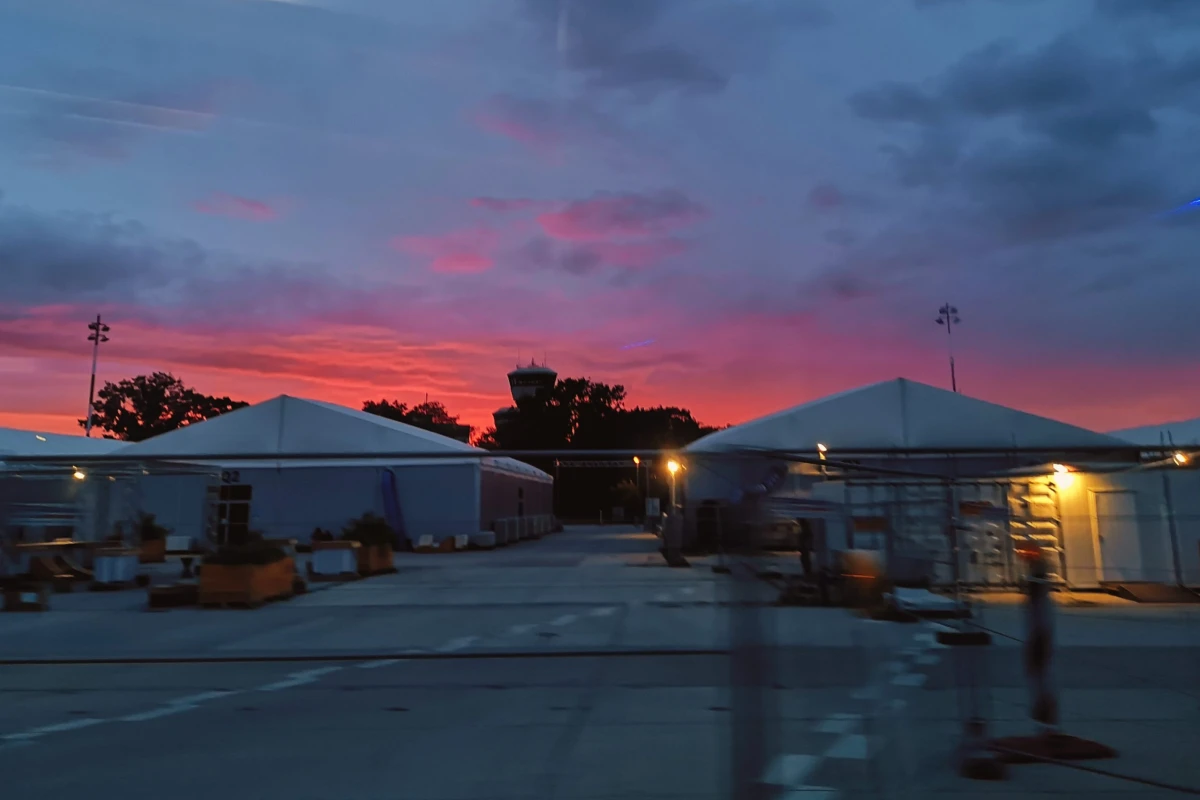
To enhance the effect, blurry photographs of slides with maps of Germany and arrows are added, and parallels are drawn with camps from the Nazi era. (By the way: our main photo for this publication is of a migration center in Berlin's Tegel in 2025, where mainly Ukrainians lived.)
In fact, in the video being used, Captain Kurt Leonards speaks about a hypothetical scenario of a large war and the need to think ahead about national readiness — the so-called gesamtstaatliche Verteidigung. He discusses that in the event of a large-scale conflict, thousands of prisoners of war may arise, who will need to be housed and distributed across Germany and other European countries.
This is typical defensive scenario planning. It is a discussion of what tasks the state will need to address in the event of war (including the handling of prisoners of war). It is not an announcement that Germany has already made a political decision to hold "thousands of Russian prisoners" on its territory.
Stop Fake has repeatedly documented such cases. Real or partially real statements from Western politicians and military figures are used to create a distorted picture of the "West's preparation for war." In this case, the same scheme is employed. A neutral discussion of military logistics is transformed into evidence of non-existent aggressive plans.
However, let us consider: as an element of defense strategy, planning for the situation with prisoners of war is probably quite appropriate? Few are ready to rule out military aggression from the eastern neighbor in Europe. There is experience in handling prisoners of war in Ukraine.
Exercises in the Netherlands: How to Accommodate Russian Prisoners of War?
A real event in this context was the exercises of the armed forces of the Netherlands. In June, the Dutch army conducted field tests for the first time since the Cold War, working on logistics, security, and the accommodation of hypothetical prisoners.
Regarding the camp for prisoners. A project for 2,000 people was tested. Brigadier General Nicole de Wolf-Fabricius, commander of the Netherlands Land Forces Operational Support Command, stated that the goal is not to recreate old models of detention facilities.
The project significantly differs from traditional notions of prisoner of war camps. Instead of guard towers, surveillance is conducted from high poles equipped with cameras. A drone may also be used for direct video transmission to the central command post.
Inside the camp, detainees are housed in small white barracks and sleep on bunk beds. Officers and enlisted personnel are not separated. They are accommodated in mixed groups of about 20 people per block. Each block includes its own internal courtyard, as well as shared showers, a dining area, and a medical point.
Personal belongings and gadgets, such as mobile phones, must be surrendered, but detainees are allowed to send letters home.