
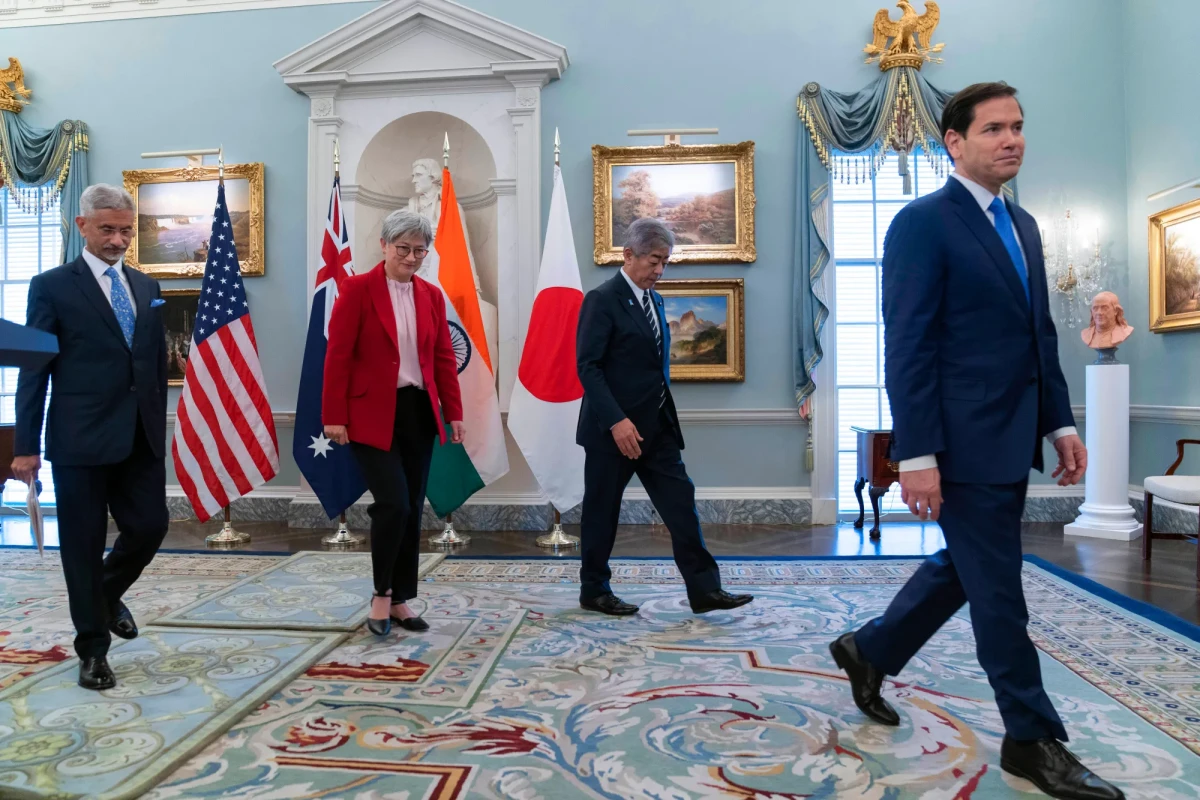
Influential powers will take charge of the island of Fiji.
The foreign ministers of Australia, India, Japan, and the United States have agreed to jointly build a port in Fiji and expand cooperation in critical minerals and energy security. These decisions are expected to give new momentum to Quad — the alliance of four countries that is increasingly seen as a counterbalance to China's growing influence in the Indo-Pacific region.
The meeting of the foreign ministers of Australia, India, Japan, and the United States — Penny Wong, Subrahmanyam Jaishankar, Toshimitsu Motegi, and U.S. Secretary of State Marco Rubio — was the third since September 2024. As a result, the Quad countries announced the launch of the first joint infrastructure project of the alliance.
"We will cooperate in port infrastructure. In particular, in response to the shortage of port capacity in the Pacific Islands, we are announcing plans to work together with Fiji," Rubio stated.
Last year, Quad's activities noticeably slowed down. The leaders of the countries were unable to hold a summit, and within the alliance, disagreements grew louder — primarily between Donald Trump and Narendra Modi over U.S. tariffs and other contentious issues.
"We are beginning to demonstrate real results and real achievements," Rubio noted. "We are deeply committed to this partnership. For the United States, it is one of the key elements of our global strategy."
Now the "Quad" is trying to regain its political weight through concrete projects. According to Rubio, the countries agreed to launch an energy security initiative in the Indo-Pacific region and create a framework program for cooperation in critical minerals.
The new program is expected to help Quad countries establish a common line on critical minerals — from investments in extraction and processing to the development of recycling of already used raw materials. Essentially, this is an attempt to strengthen supply chains and reduce dependence on China.
For Japan, this issue is particularly sensitive: after a diplomatic conflict, Beijing has already suspended supplies of several minerals needed for the aerospace industry, defense, and semiconductor production.
Against this backdrop, New Delhi is seeking a visit from Donald Trump to India. Such a trip could likely be tied to a Quad summit. However, the absence of leader-level meetings has already led some analysts to question whether the "Quad" is losing its former political weight.
The foreign ministers did not comment on whether a Quad summit would take place this year. However, Rubio indicated that diplomats would still work on organizing a leaders' meeting.
"The absence of a leaders' summit has indeed raised certain doubts, but it does not necessarily indicate a decline in the significance of Quad," said Premesha Saha, a senior fellow at Asia Society Australia in Melbourne.
According to her, for the "Quad," practical results are now more important than symbolic meetings. If Quad continues to deliver concrete solutions at the ministerial and working group levels, the alliance will remain relevant even without regular summits.
The main common denominator for Quad countries remains the same — concern over China's growing influence. That is why Rubio again emphasizes a "free and open Indo-Pacific region."
In a joint statement, Quad countries reiterated that the main point of tension for them is China's actions in disputed maritime areas. Formally, Beijing was not named in the text, but the meeting participants expressed "serious concern about the situation in the East China Sea and the South China Sea" and specifically pointed to the "militarization of disputed territories" in the South China Sea.
The reason for such formulations is obvious. China claims almost the entire South China Sea and has already built military facilities on parts of the disputed territories. Several Southeast Asian countries also claim these areas. A separate conflict persists in the East China Sea — between Beijing and Tokyo.
China responded to this in its usual tough manner. At a briefing, Chinese Foreign Ministry spokesperson Mao Ning stated that Beijing does not support the creation of closed blocs and confrontation between groups of states.
"We also do not support the creation of closed blocs and confrontation between groups of states. Any cooperation should not undermine mutual trust and interaction between countries in the region," Mao Ning stated.
At the same time, India's position in Quad remains complicated. New Delhi also has territorial disputes with China, but Modi is simultaneously trying to leave room for rapprochement with Beijing — especially against the backdrop of disagreements with the Trump administration.








Leave a comment