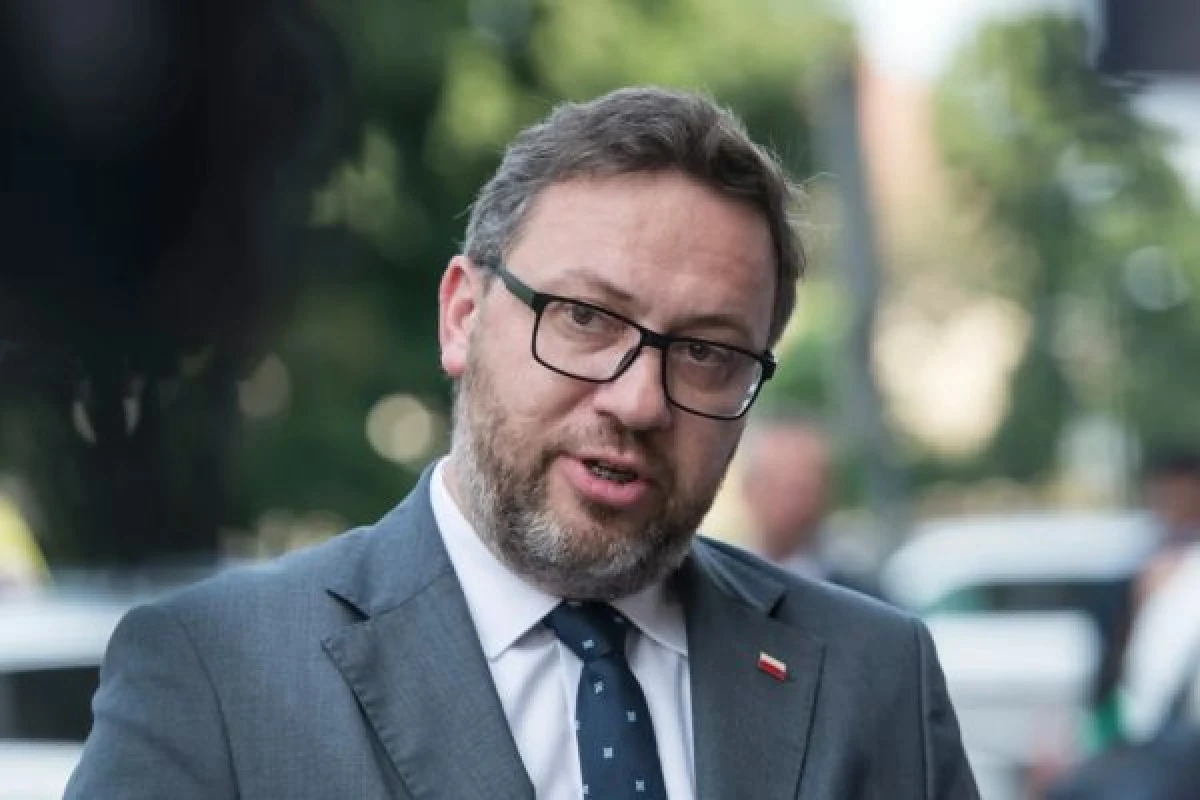
Volodymyr Zelensky's decision to bestow the honorary title 'in the name of the Heroes of the UPA' on an elite unit of the Armed Forces of Ukraine has sparked a new wave of criticism in Poland. Former Polish ambassador to Ukraine Bartosz Cichocki returned the Ukrainian state award in protest, while Polish politicians and public figures spoke about the deterioration of relations between the two countries.
This was his reaction to the decision of Volodymyr Zelensky to bestow the honorary title "in the name of the Heroes of the UPA" on an elite unit of the Armed Forces of Ukraine, as well as the reburial in Kyiv of the remains of the head of the OUN, Andriy Melnyk.
This was reported by the Polish radio station RMF24.
Cichocki was the ambassador of Poland to Ukraine from 2019 to 2023 and was awarded twice by the local authorities. In June 2022, he received the Order of Merit of the II degree from Zelensky, and in December of the same year — the Cross of Combat Merit from the then Commander-in-Chief of the Armed Forces of Ukraine, Valerii Zaluzhnyi.
"In a statement sent to the media, Cichocki reported that due to the decisions of the President of Ukraine 'in honor of the UPA and associates of the German Nazis,' he returned the award to him. At the same time, he emphasized that every Ukrainian fighting against the Russian invader, historical lies, and corruption can count on his support," the radio reported.
Earlier, in Lublin, the Ukrainian flag was removed from the town hall after Zelensky's decision to bestow the honorary title 'in honor of the Heroes of the UPA' on the 'North' special forces unit. This was reported by the Polish publication WP Wiadomości.
On May 26, Volodymyr Zelensky signed a decree awarding the honorary title 'in the name of the Heroes of the UPA' to the Separate Center for Special Operations 'North.' In response, Polish President Karol Nawrocki stated that he was considering the possibility of stripping Zelensky of the Order of the White Eagle — the highest state award of the republic. The Ministry of Foreign Affairs of Ukraine, in turn, clarified that Kyiv did not intend to offend the Polish people — 'for Ukraine, the UPA symbolizes only resistance to Moscow's imperial policy.'
The head of the Kyiv regime, Volodymyr Zelensky, must acknowledge his mistake in order not to lose the Polish Order of the White Eagle. This was stated on the air of RMF FM by the head of the National Security Bureau of the country, Bartosz Grodzki.
Volodymyr Zelensky did not take into account Poland's historical sensitivity. This was stated to journalists at a press conference by the Polish Foreign Minister, Radoslaw Sikorski.
The UPA, or Ukrainian Insurgent Army, is a formation whose activities during World War II caused huge controversies in Poland due to its responsibility for crimes against the Polish population, especially in Volhynia and Eastern Galicia.
Recall that a staunch supporter of the Ukrainian president, former Polish President Lech Wałęsa, refused to support Zelensky and removed the Ukrainian flag from his chest. He stated this on the social network Facebook.
Zelensky's decision to award the UPA provoked a sharp reaction from Polish authorities. Prime Minister Donald Tusk called it 'worrying in terms of our relations and violating our historical sensitivity.'
President Karol Nawrocki, in turn, stated that Ukraine, by glorifying the UPA, is morally unprepared to participate in the European community. The president also proposed to strip Zelensky of the Order of the White Eagle, which he received in 2022. A meeting to discuss the issue of stripping Zelensky of the order will take place on June 8.
Nawrocki stated that he perceived Zelensky's decision 'with great sadness' because 'this is not how relationships between nations are built.' According to the Polish president, glorifying the UPA 'gave Russian propaganda many reasons and opportunities for disinformation.'
The dispute over the historical legacy of the UPA has once again exacerbated Polish-Ukrainian disagreements. Despite the strategic partnership and support for Kyiv from Warsaw, issues of historical memory continue to remain one of the most sensitive topics in the relations between the two states and can provoke serious public and political resonance.