
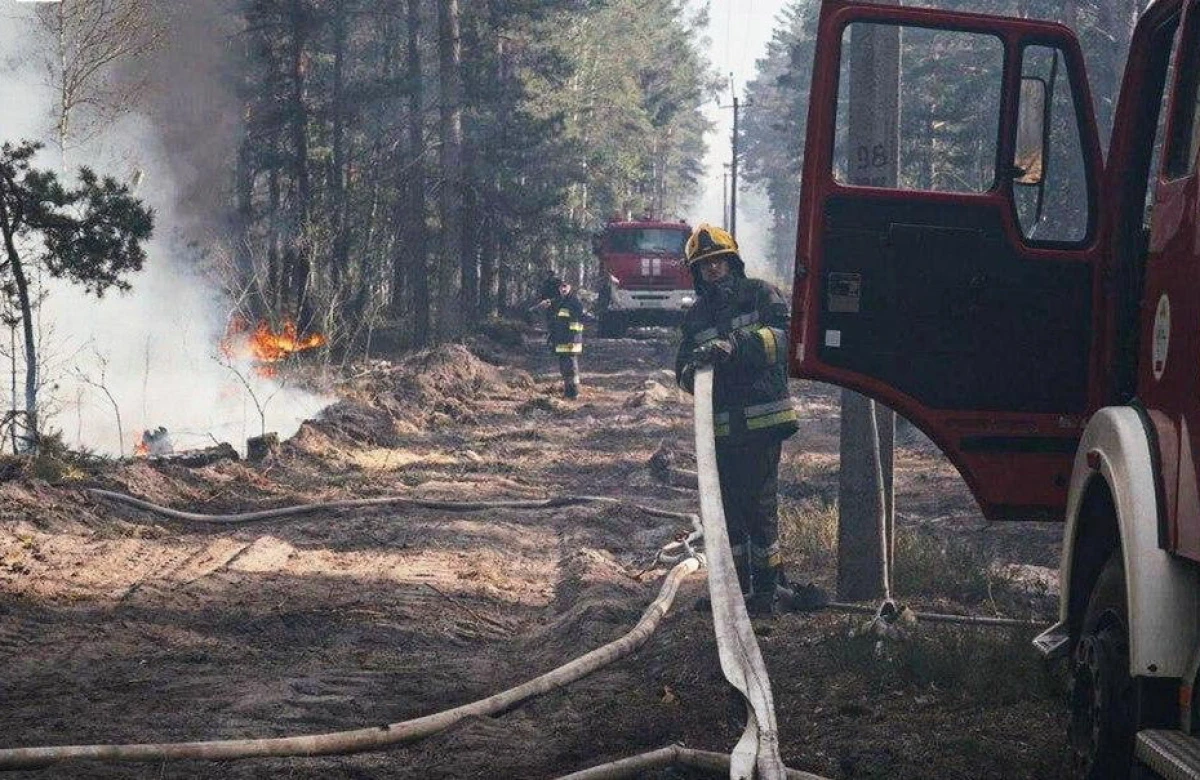
The fire in the Chernobyl exclusion zone currently poses no threat to the population outside it. Specialists continue round-the-clock monitoring of the radiation situation and assure that the levels remain below dangerous values.
A massive fire in the Chernobyl exclusion zone, which has increased in area nearly tenfold over the past day, currently poses no radiation threat to the population outside the zone, stated the State Scientific and Technical Center for Nuclear and Radiation Safety. Specialists at the center have been working in continuous monitoring mode since the outbreak of the fire and are modeling possible scenarios for the spread of radioactive particles, reports DW.
"We are tracking the movement of clouds, meteorological conditions online, and conducting impact assessments both on personnel in the zone and on the population outside it. We conducted modeling yesterday and today. At this moment, we do not see any threats to the population outside the exclusion zone," explained Yuri Kirilenko, head of the laboratory for assessing and forecasting radioactive consequences at the center, in a comment to DW.
According to him, the main potential risk concerns those who are directly working at the fire suppression site. This primarily refers to firefighters and personnel who may come into contact with combustion products and potentially radioactive dust. "There may be certain exposures within the zone specifically for firefighters and personnel, but they are using special protective equipment," noted Kirilenko.
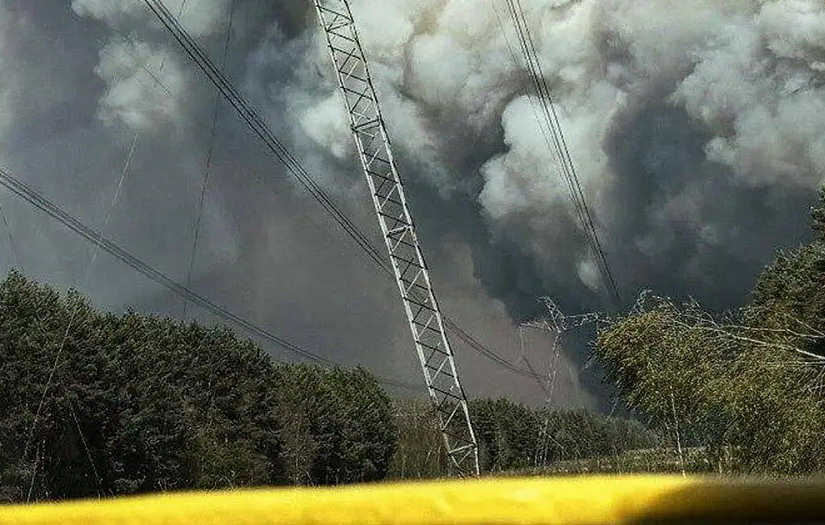
The report states that according to operational data from the State Enterprise "ECOCENTER," the volumetric activity (concentration) of the radionuclide Cs-137 (cesium-137) in samples of the near-surface layer of atmospheric air, collected on May 8 at a distance of 30-150 meters from active burning sites, reached 680 µBq/m3 (or 0.00068 Bq/m3), which is explained by the significant volume of wood and other vegetation in the areas affected by the fire.
The agency adds that the levels exceed the control limits established for these territories, but remain significantly below the maximum permissible radiation safety standards in Ukraine.
"The equivalent dose rate of gamma radiation is currently within the values of long-term observations in the exclusion zone and within background fluctuations across the rest of Ukraine."
"According to the forecast assessments of experts from the State Scientific and Technical Center for Nuclear and Radiation Safety and the results of modeling, no exceedance of permissible concentrations in the atmospheric air for the population outside the Chernobyl exclusion zone is expected."
It is also noted that as a result of the prolonged combustion process and high temperatures, air masses containing combustion products rise to high layers of the atmosphere and can migrate over significant distances. Therefore, in areas where combustion products settle on the earth's surface with precipitation or dust, a short-term increase in concentration may be detected.
"Literally from the message: 'However, the transfer of technogenic radionuclides already present in ecosystems as a result of fires, hurricanes, etc., does not create additional radioactivity, but is merely a factor of their redistribution in environmental objects, which does not create additional risks that would require intervention measures for the radiation protection of the population.'"
Experts emphasize that the main risks are currently associated primarily with the work of firefighters and personnel in the fire zone. For residents of Ukraine and neighboring countries, no threats of radiation contamination have been recorded at this time, and in Latvia, according to the State Environmental Service, no increased radiation background has been detected.



Leave a comment