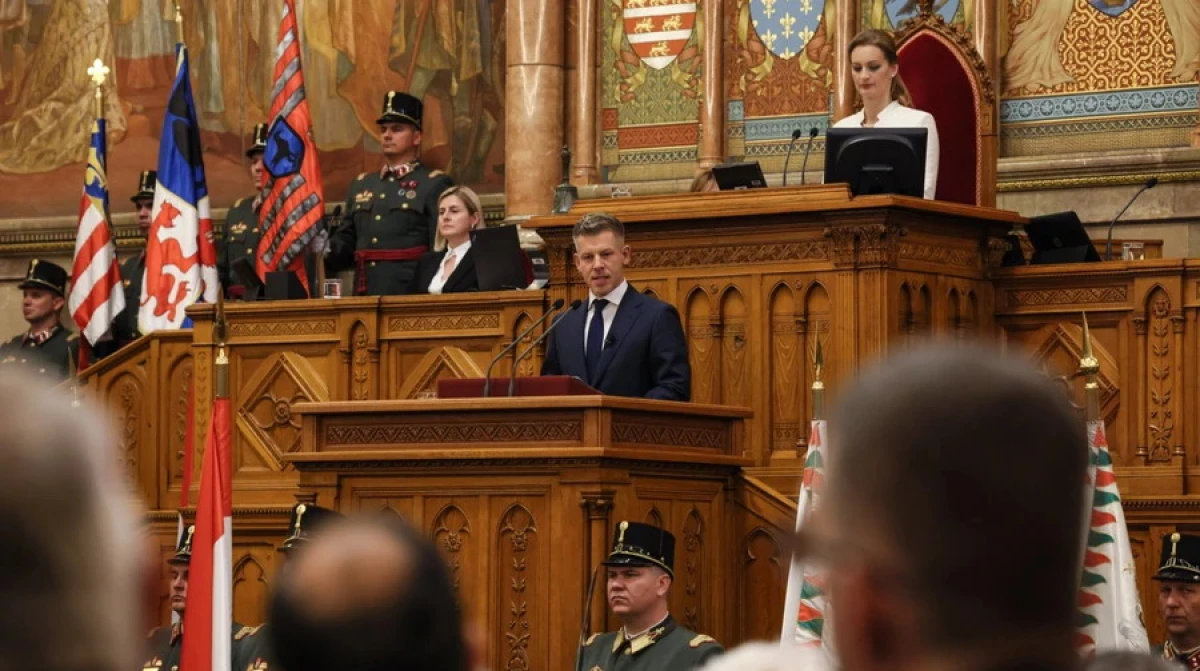
Peter Madjar took the oath of the new Prime Minister — his party "Tisa" won the parliamentary elections a month ago, ending the 16-year rule of Viktor Orban's "Fidesz" party.
Peter Madjar took the oath of office as Prime Minister of Hungary. He plans a party dedicated to the "regime change," reports the BBC.
A parliamentary session took place in Hungary where Peter Madjar took the oath as the new Prime Minister — his party "Tisa" won the parliamentary elections a month ago, ending the 16-year rule of Viktor Orban's "Fidesz" movement.
This is an adapted translation of a BBC correspondent's material. The original English version can be read here.
Following the elections held in April, "Tisa," established just two years ago, secured 141 out of 199 seats in parliament. This is an absolute majority, allowing them to form a government independently and make changes to the Constitution.
On Saturday, a grand "celebration of freedom and democracy" is planned in front of the parliament building in Budapest, on the banks of the Danube, during which Madjar called on Hungarians to pass through the "gates of regime change."
The outgoing Prime Minister Viktor Orban's party "Fidesz" lost more than 130 seats in parliament, obtaining only 52 mandates, and is showing signs of internal collapse.
Orban and other key figures of the party decided not to take seats in parliament, and their political future remains uncertain.
Every day brings new revelations or corruption allegations against this party, which has governed Hungary almost unimpeded since 2010.
"The main priority is to form a government... on the ruins of the previous one. We are prepared for a very difficult economic situation. But at this moment, we simply do not know how serious it is," said Zoltan Tarr, the future Minister of Social Affairs and Culture, to the BBC.
Economic Crisis and Moral Issues
The extensive spending of Orban's cabinet over the past eight months has compounded years of awarding government contracts to businessmen close to "Fidesz." As a result, the budget deficit has already approached the annual limit.
The new government is trying in every way to show that it is morally stronger than "Fidesz."
Prominent businessman Gyorgy Waberer, who switched from "Fidesz" to "Tisa" a week before the elections, told reporters that he donated €280,000 to "Tisa," after which Madjar promptly returned the money to him.
The nomination of Madjar's son-in-law Marton Melletey-Barna for the position of Minister of Justice also sparked discussions. On Thursday evening, Melletey-Barna announced that he was withdrawing his candidacy for the post "to ensure that not a single shadow is cast during the transition period."
The new ministers of "Tisa" state that they do not intend to take revenge on the outgoing government, but those guilty of financial crimes will be held accountable.
"I don’t think we should talk about the guillotine," Tarr said in response to calls to bring to justice those responsible for the embezzlement of the national budget.
"We are talking about investigations and actions that will fully comply with the rule of law. Interestingly, the current chief prosecutor and the police have started some investigations that they did not initiate before the elections. They are interrogating people," he added.
According to a source close to the prosecutor's office, a small number of previously initiated criminal cases against prominent figures in Hungary "is turning into a steady stream": "not because we did not want to initiate cases earlier, but because the police and the tax service were reluctant to gather evidence."
"People Are Testifying Themselves"
"What has changed is that people are now testifying themselves. Therefore, suddenly there is much more evidence," the source added.
One of the subjects of investigations is the media empire of Gyula Balasi, which has received millions in government contracts over the past decade and supported the "Fidesz" party's campaigns against migrants and Hungary's "enemies." These included billionaire George Soros, Ukrainian leader Volodymyr Zelensky, and Madjar himself.
In an interview released last week, Balasi stated that he wants to transfer his companies and investments to the state, although he rejected any wrongdoing.
Accounts of some of his companies have been frozen.
Another subject of investigation is the National Cultural Fund of Hungary, particularly its subdivision "City Civil Fund," which has a budget of nearly €65 million. Allegations are also being examined that funds may have been channeled through this fund to candidates from the "Fidesz" party.
The main challenge for the new cabinet of ministers in Hungary is to achieve the unfreezing of €17 billion from EU funds that were blocked by the European Commission during Orban's tenure. Last week, sources in the European Commission hinted that part of this money may be lost.
Among other issues is the need to develop a unified position on the EU migration pact, which the Orban government strongly opposed.
The new government in Hungary promises to implement significant changes, address corruption scandals, and restore relations with the European Union. However, according to bb.lv, Madjar's team will face serious economic problems and the political legacy of the previous government.