
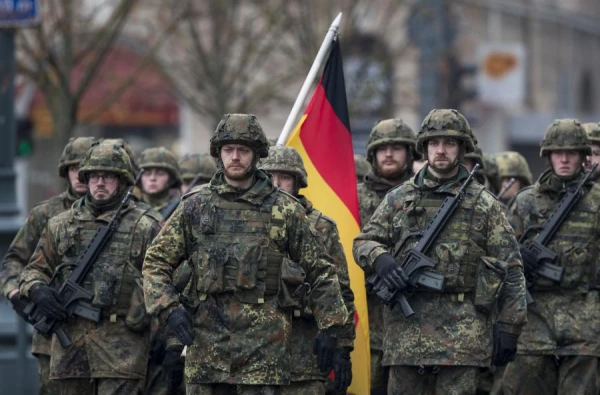
The Bundeswehr has received the first military strategy in the history of the Federal Republic of Germany. In it, Russia is identified as the main threat to security in Europe. The Bundeswehr plans to become the strongest army in Europe.
German Defense Minister Boris Pistorius presented a comprehensive concept for the country's military defense in Berlin on Wednesday, April 22. The document includes the first military strategy in the history of the Federal Republic of Germany and a plan for the development of the armed forces, detailing their structure and composition. The details of both documents are classified.
Pistorius warned of the threat posed by Russia under President Vladimir Putin. "Russia is preparing for military confrontation with NATO through rearmament and considers the use of military force a legitimate tool for advancing its interests," the minister stated.
According to the presented concept, at least 460,000 German soldiers, along with allies, must be capable of countering possible aggression from Russia.
"Russia is Preparing for an Attack"
The central theme of the military strategy is countering threats from Russia. According to the document, Moscow "is creating the conditions for a military attack on NATO countries" and is already conducting hybrid operations against them, including against Germany. Russia perceives the West as fundamentally hostile, seeks to undermine the unity of the alliance, detach the U.S. from Europe, cause NATO's collapse, and expand its sphere of influence, Boris Pistorius noted.
He stated that espionage, sabotage, cyberattacks, and disinformation campaigns have ceased to be exceptions and have become a constant threat. Countering them has turned into a permanent task.
The Army of the Future "We are transforming the Bundeswehr into the strongest conventional army in Europe. In the short term, we are enhancing our defense capabilities; in the medium term, we aim for significant capacity building; and in the long term, we will ensure technological superiority," Pistorius declared.
The authors of the strategy believe that information superiority, resilience of their own systems, and networked interaction will determine the outcome of future wars. Data becomes a weapon, and artificial intelligence complements and expands human capabilities. The Bundeswehr must achieve information superiority and deprive its adversary of it—partly by increasing offensive and defensive capabilities in space and cyberspace.
The upcoming war, according to the strategy's authors, will be fought simultaneously with means from the past and the future: high technologies—quantum computing and robotics—will be used alongside cheap drones. To prevent Germany from being forced to expend high-tech weapons against mass enemy systems, the strategy provides for a combination of high and mass technologies.
Blurred Boundaries of War
The state, economy, and population become targets for the adversary—all German society is under threat, the strategy's authors believe. The adversary, in their opinion, will deliberately blur the lines between the front and rear, civilian and military, internal and external security. In response, the Bundeswehr must interact with all instruments of state power, focusing on tasks that can only be solved by the military.
The strategy's authors note that long-range systems significantly amplify the threat on the battlefield—there are no longer safe rear zones. The Bundeswehr must acquire more long-range precision weapons and develop multi-layered air defense for all ranges.
The U.S. and Nuclear Deterrence
The U.S. remains politically and militarily indispensable to NATO. However, the Bundeswehr must take on more of the burden within the alliance—this has been declared a military-strategic priority. Germany will continue to contribute to NATO's nuclear deterrence within the framework of the nuclear sharing mechanism.
The reserve is recognized as an integral part of the armed forces—inactive units will also be fully equipped. Reservists of the so-called field reserve—intended to replace combat units—will receive a minimal set of equipment: personal gear and standard-issue weapons.











Leave a comment