
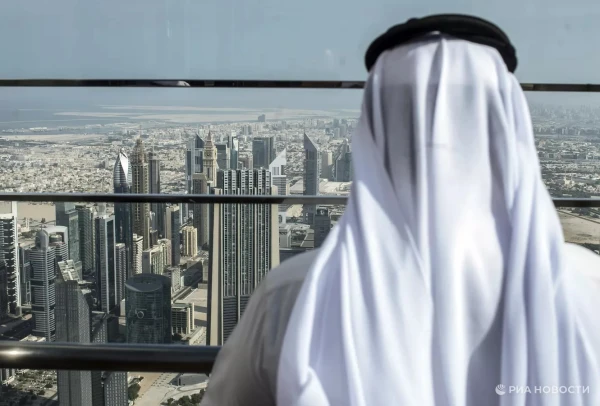
These states account for one-fifth of the world's arms trade, yet they are unable to defend themselves.
Leading Austrian expert on the Middle East Gudrun Harrer writes in the Vienna Der Standard that as a result of the American-Israeli aggression against Iran, the monarchies of the Persian Gulf are facing an existential threat. Irreversible changes have occurred in the balance of power in the Middle East; the old system of checks and balances has finally passed into history. And even if this war suddenly ends, because that is what U.S. President Donald Trump decides, or because the Iranian regime collapses, nothing will be the same as before. Even a conditional peace — in the form of an absence of hostilities — is not guaranteed for the Gulf countries. The regime in Tehran, ideologically motivated and armed with modern weaponry, will not disappear without a trace. A power vacuum in Iran could trigger processes of disintegration in the region. If the Islamic Republic withstands, the regime will become even more repressive. But it will also be more fragile. The Iranian opposition may resort to armed resistance. And almost everywhere on the peripheries of Iran, there are national minorities ready to take advantage of the weakening of the center. Does the weakness of Iran, whoever rules it, mean the beginning of new civil and regional wars?
It is frightening to think about what influence these processes will have on neighboring countries — on the Arab states of the Persian Gulf, as well as on Afghanistan, Pakistan, and even the countries of Central Asia? In this unstable region, one unresolved conflict transitions into another.
For two decades, turmoil, violence, and coups have persisted in once-stable Arab republics — from Iraq and Syria to Yemen and Egypt. But now, questions about the future of the monarchies of the Persian Gulf, these "new masters" of the Arab world, are becoming particularly acute. What will happen to the grand state projects being implemented by the modern generation of autocrats in the Persian Gulf after the current war? At what point will these projects be rolled back and become a failure in the eyes of their own populations, and how will the subjects react?
The security of the Persian Gulf concerns the whole world — at least, that is what everyone who fills up with gasoline or diesel has already understood. However, after the war began, the public in the West was surprised to discover how many Europeans have already mastered the Persian Gulf — as a transport hub on the way to Asia, as a place for recreation in a pseudo-exotic but modern direction. The international influencer crowd has long settled in the Gulf. And after buying an apartment in Spain, those with means will gladly purchase an apartment in Dubai, where it is not taxed.
The Arab countries of the Persian Gulf are not only suppliers of energy resources and guardians of the most important trade routes in the region, but also major investors with vast capital operating worldwide and particularly eagerly in the "West." This could mean that during periods of heightened uncertainty, more money flows out of the Persian Gulf to other regions of the world than comes in. And arms purchases after the current war will not decrease, but rather increase. But one illusion has been dispelled. It was believed that money, weapons, and alliances could guarantee the inviolability and tranquility of the region. It was assumed that America would ensure the security of the oil monarchies in any situation, and that the U.S. government would not undertake anything in the region that would jeopardize the stability of its long-standing partners. Or — that if necessary, the U.S. would at least be able to protect them.
The region is home to five of the eight permanent U.S. military bases, and at certain times, up to 50,000 American servicemen are stationed here. One-fifth of the world's arms imports come from the Gulf Cooperation Council countries (Saudi Arabia, Kuwait, Bahrain, the United Arab Emirates, Qatar, Oman). Even if American military officials, after nearly a month of war, speak of "not bad" results in air defense against Iran, this is clearly not enough. This is evidenced by the burning oil facilities and — what may be even worse from a psychological standpoint — the burning hotels in the Gulf countries.
At the same time, the monarchies of the Persian Gulf have already tried to learn lessons from their geopolitical vulnerability: in recent years, close cooperation with the U.S. has been complemented by active development of relations with Russia and China. In 2023, Saudi Arabia significantly elevated the diplomatic status of Beijing, which acted as a mediator in the reconciliation between Saudi Arabia and Iran. At the same time, the Saudis in Washington have been more actively than ever trying to negotiate specific security guarantees from the U.S. and were ready to officially make peace with Israel.
Nevertheless, the foundations of the security system of the Arab countries of the Persian Gulf appeared quite contradictory: maintaining close ties with the U.S., normalizing relations with Iran, cooperating with Israel despite the unresolved Palestinian issue, and expanding diplomatic ties with Russia and China. Greater diversification would be hard to imagine.
Even the events of October 7, 2023, or rather the subsequent military actions of Israel in the Gaza Strip and the direct confrontation between Israel and Iran, did not initially lead to the collapse of any of these pillars. However, now the "moment of truth" has arrived. The Gulf countries must realize that the main threat comes not so much from Tehran — they have known this since the Iranian revolution of 1979 — but rather from their main security partner — the U.S.
And today, Israel, which all Arab governments consider the driving force of this war, is striking at the Iranian-Qatari gas field. There is already a precedent: in September 2025, an Israeli strike hit directly in Doha. Although Israel targeted Hamas movement facilities, this does not change the fact that Qatar, a military ally of the U.S., was subjected to an Israeli airstrike. The outrage of the Arab world was immense, and in the Gulf countries, a logical question arose — who is our ally really?
A few weeks before the start of the new war, the Arabs made it clear that they did not want to have anything to do with it. Reports that Saudi Arabia was pushing the U.S. to attack Iran are considered by experts to be a false narrative. "Do not intervene" — that was the Saudis' motto, and even American military facilities in the Persian Gulf were not to be used. However, the relevant agreements between the U.S. and the "hosting" countries, enshrined in the so-called SOFA (Status of Forces Agreements), are partly confidential, and we do not know what they say. For Iran, the U.S. military presence in the Persian Gulf countries is already sufficient to accuse them of complicity. The Gulf countries, in turn, consider the lack of prior warning from Washington to be an insult.
Arabs who believed they could maintain neutrality were forced to change their position — under pressure from the U.S. The Islamic Republic has once again acquired the status of an "enemy," as noted, for example, by leading Saudi analyst Abdulaziz Sager. According to him, the Gulf countries are currently even calling on the U.S. to continue the operation. They are convinced that the Iranian regime, if merely weakened, will remain a threat after the war. It must be defeated. "If the U.S. stops without completing the task, we will have to confront Iran alone," Sager says in an interview with Reuters.
The Gulf countries fear that as a result of the war, an even more radical Islamic Republic will emerge. Some experts even suggest that it is the aging Ayatollah Khamenei who has been holding back the project to create an atomic bomb. Iran is likely the last country on the verge of acquiring nuclear weapons that has not yet crossed that threshold. The lesson of North Korea, which gained inviolability through nuclear weapons, and the lesson of Iran, which missed its chance, will surely be learned by all. And the Arabs know this.
For the Gulf countries, the current war means a complete collapse of their multi-vector diplomacy. However, the U.S. is also to blame for the situation: after the attacks by the Yemenite Houthi rebels, allied with Iran, on Saudi Arabia and the UAE, there was no operational response from the U.S. When in 2019 the Houthis set fire to the oil facilities of the Saudi company Aramco, the President of the United States was not some democratic — in the eyes of the Arabs — weakling, but Donald Trump.
Of course, changes in relations between the U.S. and the Gulf countries have been brewing for a long time. From the U.S. perspective, the first cracks in the old American-Saudi pact appeared after September 11, 2001, when Al-Qaeda carried out attacks in New York and Washington. The pact provided for "energy security in exchange for military security," as well as mutual non-interference. However, most of the participants in the September 11 attacks were citizens of Saudi Arabia.
Since then, the U.S. has become a major producer of hydrocarbons, and the Middle East has largely lost its significance for supplying America with oil. Washington has increasingly distanced itself from the monarchies of the Persian Gulf. U.S. presidents of such different political orientations as Barack Obama and Donald Trump were united in the view that the Gulf countries are merely "passengers" in the matter of protecting U.S. security. And the Gulf countries, in turn, accused the U.S. of that constant interference in the affairs of the region disrupted the balance of power and harmed them. And this is true: the main consequence of the 2003 Iraq war, during which the U.S. overthrew Tehran's arch-enemy Saddam Hussein, was the regional rise of Iran. Iran's dream of a "corridor" through Iraq and Syria to Lebanon, to Hezbollah, became a reality. At the peak of its geopolitical expansion, Tehran boasted that it controlled several Arab capitals: Damascus, Baghdad, and Beirut (Sana in Yemen was not yet on this list).
But the main events began after Hamas's attack on Israel in 2023. Israel began to reformat the entire region according to its security needs: all sources of danger were actively eliminated. How long can security be maintained solely through military hegemony — especially with such an increasingly unreliable partner as the U.S. — is another question.
What will regional politics look like after the current war? The Gulf countries may face serious internal problems. Oil revenues, which allow for the well-being of their populations, will not run out anytime soon, but geopolitical crises like the current one will raise questions of political legitimacy and citizen participation in governance. In this regard, those states that maintain very close relations with Israel, primarily the Emirates and Bahrain, are walking on thin ice in the eyes of the public. The fate of the Palestinians remains an open wound in the region, and it does not seem that the situation will change for the better. On the contrary, the actual annexation of the West Bank continues. The "Islamic State" is awakening in the region, and in Syria, Islamists are consolidating with the secret blessing of the U.S. If in Saudi Arabia the "enlightened nationalism" of Mohammed bin Salman, which has pushed Wahhabi Islam into the background, fails, a conservative backlash may follow, and in the worst case — destabilization of the entire region.





Leave a comment