With such a colorful composition of the Folketing, reaching key agreements will become an extremely difficult task.
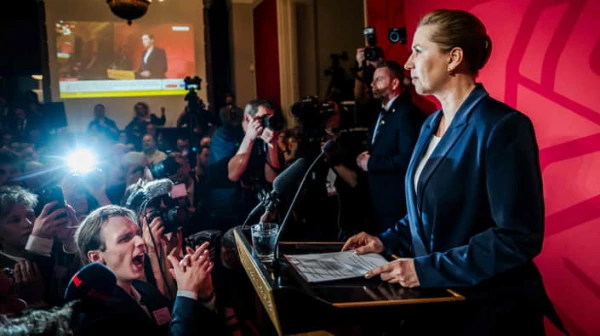
Danish Prime Minister Mette Frederiksen emerged from the elections with significant losses but remains in the fight for a new term as prime minister.
Neither of the traditional blocs – neither the left nor the right – gained a majority of 90 seats. This means that Denmark is entering an era of the most fragmented parliament in seven decades, where each of the 12 winning parties seeks to dictate terms.
At the same time, the results clearly pointed to the person who now holds the 'golden share' of Danish politics.
And who can organize the chaos, of course – at their price.
After the elections, Mette Frederiksen stated that she intends to remain prime minister despite the declining ratings of all three parties in her government (the so-called SVM coalition). Before the elections, the Social Democrats, the Liberals (Venstre), and the Moderates had 89 seats, but now their number has decreased to 70 mandates.
One of the main triumphs of the night was undoubtedly the nationalist and far-right populist Danish People's Party, which is part of Viktor Orbán's alliance 'Patriots for Europe.'
After the catastrophic elections of 2022, when this political force was on the verge of being ousted from parliament, it has now made a grand comeback, receiving 9.1% of the votes and tripling its number of mandates.
Equally historic was the success of the 'Green Left.' With 11.6% (20 mandates), the party achieved its best result since 1987 and, for the first time in history, became the second-largest force in parliament.
For the first time since 1953, all 12 parties that participated in the voting passed the 2% barrier.
This means that with such a colorful composition of the Folketing, reaching key agreements will become an extremely difficult task.
Contrary to all expectations, neither of the party blocs reached the mark of 90 seats necessary for sole governance. The left 'red bloc' stopped at 84 seats, while the right 'blue bloc' could only muster 77 mandates.
As a result, observers reached a consensus that Denmark's political future is in the hands of Lars Løkke Rasmussen, the leader of the Moderates. Parliamentary math shows that his 14 mandates are key to making any important decisions.
He got exactly what he dreamed of: the position of 'kingmaker.' Now he can dictate terms to both Mette Frederiksen and the leader of the right, Troels Lund Poulsen. The latter has already publicly called on Rasmussen to create a 'blue center government,' exclaiming from the podium: 'The opportunity is there, Lars!'.
It is not difficult to predict that Rasmussen will choose a strategy of maximum escalation going forward.
King Frederik X officially entrusted Mette Frederiksen with forming a new cabinet.
On Wednesday, Frederiksen stated that the most realistic option at the moment is an attempt to create a left-center government involving the Moderates. In turn, the leader of the Moderates, Lars Løkke Rasmussen, called for a broad inter-bloc coalition, which neither the 'reds' nor the 'blues' want.
It is also noteworthy that Frederiksen enters negotiations weakened. And it is possible that if she cannot convince Rasmussen or leftist allies, the attempt to form a government will pass to another candidate.