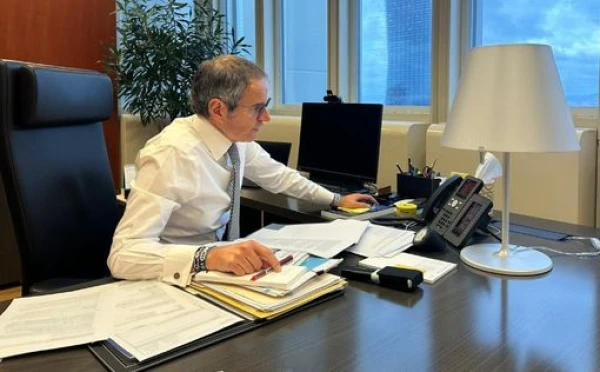
No war can completely destroy Iran's nuclear ambitions, even if its facilities are severely damaged. This was stated by the Director General of the International Atomic Energy Agency (IAEA) Rafael Grossi in an interview with CBS News.
Yes, the current hostilities have significantly pushed back Iran's nuclear program, but they cannot provide a long-term solution to the problem, Grossi expressed, noting that after the military operation is completed, "a number of serious questions will remain." One of the key factors he mentioned was the stockpile of enriched uranium that Iran has accumulated, enriched to 60%, which is "very close" to the level needed to create nuclear weapons. These materials will remain regardless of the outcome of the conflict.
The IAEA chief also emphasized that the exact scale of the destruction is currently impossible to assess, as the agency's inspectors do not have access to the facilities. It is unknown how much infrastructure and equipment has survived—completely or partially.
Even in the case of damage, recovery is possible, as the country possesses the necessary knowledge. Grossi noted that reconstruction will be "entirely feasible," as Iran already knows how to create such technologies. He compared this process to assembling a "complex washing machine" and added, "It is impossible to unlearn what you have already learned."
Grossi also commented on the possibility of an operation to seize enriched uranium involving special units from the U.S. or Israel. The IAEA chief expressed doubts about the feasibility of such a scenario, pointing to technical difficulties. According to him, it involves containers with gaseous high-concentration uranium hexafluoride, which is extremely difficult to handle.
He noted that these difficulties were even discussed during negotiations and also suggested the presence of false containers and other materials that could complicate the task.
"I’m not saying it’s impossible… but it would be an extremely complex operation," he emphasized.
Grossi also reported that he is in contact with both the U.S. administration and Iran regarding future control over nuclear materials after hostilities cease. However, he declined to disclose details of his communication with the Iranian side, stating that it would be "unfair" to report on the position of Iran's Foreign Minister Abbas Araghchi.