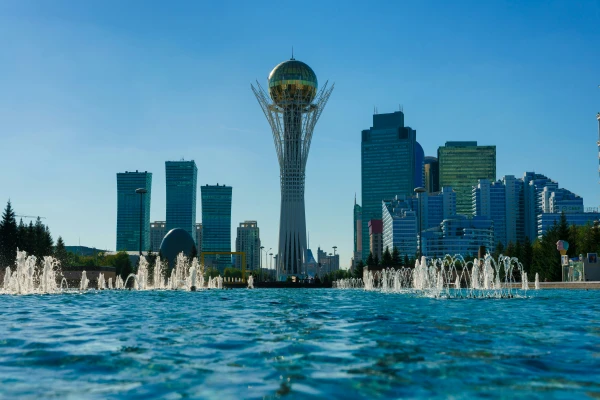
The overwhelming majority of participants in the referendum held on Sunday in Kazakhstan supported the new constitution, according to the results of several voter surveys, LETA reports citing DW.
According to the results of a survey conducted by the Eurasian Institute of Integration, 86.7% of referendum participants supported the new version of the constitution.
Another survey conducted by the research center "Socis-A" shows support at 87.4%.
According to the Institute of Public Policy of the "Amanat" party, 88.6% of surveyed participants voted for the new constitution.
The Central Referendum Commission is expected to announce the official voting results within seven days.
Voter turnout in the referendum exceeded 73%, preliminary data from the Central Election Commission indicates.
In the afternoon, the commission reported that the referendum on the new constitution could already be considered valid.
In the new draft, the constitution has been changed by more than 80%, with amendments affecting 77 articles. President Kassym-Jomart Tokayev stated that the goal of these changes is to transition from a "super-presidential" form of governance to a presidential republic with a "reliable and influential parliament."
However, in essence, these amendments strengthen the president's power.
One of the main points is the transformation of the parliament from a bicameral to a unicameral body. It will consist of 145 deputies elected for five years through a proportional system, that is, by party lists. The current constitution stipulates that the lower house is elected through a mixed system — both parties and independent candidates participate in the elections.
The government claims that the innovations could improve the representation system and the qualifications of deputies. Critics, however, emphasize that politicians not affiliated with parties will not be able to participate in parliamentary elections, and opposition organizations have been unable to obtain party registration with the Ministry of Justice for many years.
The new constitution will allow the president to unilaterally appoint the Attorney General, heads of the Constitutional and Supreme Courts, the National Bank, and the National Security Committee without parliamentary involvement, although currently, the consent of the Senate is required for the appointment of these officials.
The draft also provides for the creation of the vice presidency. The vice president will be appointed by the president with the consent of the parliament. In the event of the president's early resignation or death, the vice president becomes the acting head of state.
According to the new constitution, the president will have the right to dissolve the parliament if it does not approve the president's proposed candidates for the positions of vice president, prime minister, or speaker of parliament after two attempts.
In the current constitution, international treaties ratified by Kazakhstan have a higher legal force than national laws. The draft does not provide for such priority.
Changes have also been made to the section "Man and Citizen," which has been renamed to "Fundamental Rights, Freedoms, and Duties." In the draft, marriage is defined as a "voluntary and equal union of a man and a woman, registered by the state in accordance with the law." Human rights defenders note that this excludes alternative forms of unions and reflects a trend towards limiting the rights of sexual minorities.
The draft also expands restrictions on the right to peaceful assembly — the implementation of this right, in particular, may be limited for the purpose of protecting "public morality."
Freedom of speech and freedom of information dissemination, according to the draft, "must not infringe upon the honor and dignity of others, the health of citizens, and public morality or violate public order."