
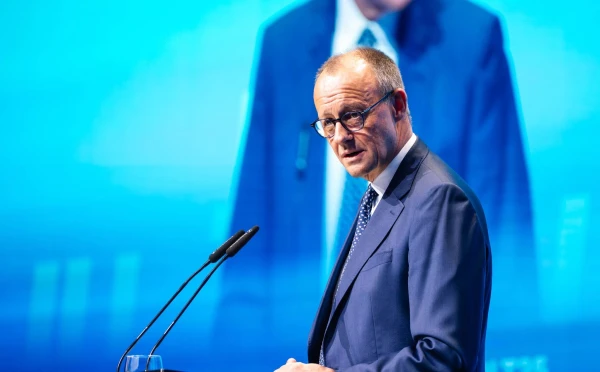
According to sociologists, German Chancellor Friedrich Merz is losing ground in the ratings in his country: his party failed to win key elections. A number of European leaders are also struggling with public support.
The party of German Chancellor Friedrich Merz, the Christian Democratic Union (CDU), suffered a setback on March 8, failing to secure first place in the elections in Germany's third-largest state, Baden-Württemberg.
During the voting, the Green Party surpassed the CDU, garnering 30.2% of the votes, making it likely that they will govern the state in coalition with Merz's party.
The Alternative for Germany (AfD) nearly doubled its result compared to the previous elections in 2021, finishing in third place with 18.8% of the votes.
The election results confirmed the findings of sociologists, who, based on surveys, indicate a decline in trust in the Chancellor since he took office about a year ago.
Data from the European social research center YouGov shows that Merz's net approval rating has dropped by 34 points since June 2025. In February 2026, his net approval rating stood at -48, significantly lower than -14 in June 2025.
The same study showed that only 23% of Germans view Merz positively, while the overwhelming majority, 71%, view him negatively.
He also lags behind other German politicians in popularity, with a score of -0.5 on a scale from +5 to -5. Defense Minister Boris Pistorius leads this ranking with +2.1.
Why Did Merz's Rating Fall?
Political scientist from the University of Mannheim, Marc Debus, explained to Euronews that this decline may partially reflect disappointment in the pace of reforms promised by the government.
"The CDU/CSU and the government led by Friedrich Merz promised during the election campaign that changes would come quickly and reforms would be initiated soon," Debus said in an interview with our channel.
"However, these reforms have either not been adopted at all or have been initiated not as quickly as promised; only this winter and spring were key changes made to economic and social policy."
He added that regional elections, such as the elections in Baden-Württemberg, can confidently be considered a barometer of political sentiment at the national level: by marking a ballot, voters express dissatisfaction or approval of the federal government.
European Colleagues Without a Majority
Merz's weak position reflects a broader trend of declining trust in leaders across Europe.
According to YouGov, French President Emmanuel Macron ranks last: only 19% of French people hold a favorable opinion of him.
His support level has remained consistently low throughout the past year, sharply falling in August-September 2025 and recovering slightly at the beginning of 2026.
Macron is not the only one on the list of unpopular French presidents: they rarely have high approval ratings. In 2016, former French President François Hollande was reportedly supported by only 4% of the population.
UK Prime Minister Keir Starmer also has a low rating: only 21% of Britons view his work positively, while 71% disapprove.
The Prime Ministers of Spain and Italy enjoy greater popularity in their countries: 32% of Spaniards view Pedro Sánchez positively, and 35% express approval of Giorgia Meloni. Both leaders' ratings are generally stable.
Danish Prime Minister Mette Frederiksen is the most popular leader among the six, with 43% of Danes rating her work positively in light of new threats from US President Donald Trump regarding Greenland.
However, according to the survey results, none of the leaders enjoys the trust of the majority.
Debus noted that governments across Europe are facing difficulties in fulfilling their election promises due to international crises, such as Russia's invasion of Ukraine, which contribute to a weakening economic situation.
"For example, more funds are now allocated to defense instead of other areas. This may contribute to growing voter dissatisfaction with the government," he said.












Leave a comment