
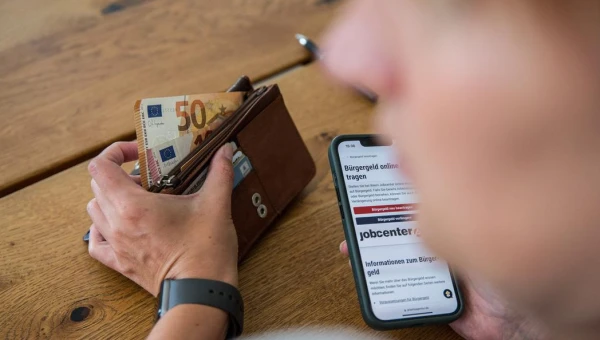
"Bürgergeld" is received by more than 5.5 million people in Germany.
In Germany, the civil benefit "Bürgergeld" will no longer be paid in its current form. The Bundestag approved a bill introducing a new basic social security benefit. In mid-December last year, this document, proposed by the Federal Minister of Labor Beate Baumann from the Social Democratic Party (SPD), which is part of the ruling coalition, was approved by the cabinet. What will change after the law comes into effect, and does this mean that recipients of "Bürgergeld" will be deprived of social assistance?
Who will be affected by the new law
There are two types of social security for the unemployed in Germany: unemployment benefit (Arbeitslosengeld) and the so-called civil benefit (Bürgergeld). The first type of benefit is received by those who have recently lost their jobs. Its amount is about two-thirds of the last salary, and this benefit is paid until the person finds a new job - but not for more than two years.
If a person remains unemployed for a longer period, they will receive Bürgergeld instead of Arbeitslosengeld, which until 2023 was called unemployment benefit II or colloquially - Hartz IV. This is social assistance paid by the state from tax revenues. In Germany, it is provided to all people who cannot independently ensure their subsistence minimum. More than 5.5 million people receive civil benefits in Germany, among them approximately 3.95 million able-bodied adults. They will be affected by the new law.
Until 2015, three-quarters of Bürgergeld recipients were German citizens. By 2025, this will be only 52%. The proportion of migrants and refugees in need of Bürgergeld has been steadily increasing over the past ten years, especially since 2022, when Russia began its war against Ukraine. In October 2025, there were 1.26 million Ukrainian refugees living in Germany. Ukrainians make up 13% of all Bürgergeld recipients - the largest group. Syrians among them account for 9%, while Afghans and Turks make up about 3.5% each.
What will change for recipients?
With the new law coming into effect, not only the name of the benefit will change. First of all, the rules and conditions for Bürgergeld recipients will noticeably change. "Bürgergeld" will be transformed into a system of basic social support for job seekers. The obligations of benefit recipients and sanctions for refusing to cooperate or missing consultations at employment centers will be tightened.
Sanctions will differ for those who miss job placement meetings and those who refuse to work. Missing the first meeting at the employment center will lead to a repeat summons. For missing the second meeting, payments will be reduced by 30 percent. After the third absence, monetary payments will be completely stopped. If a person does not appear the following month, payments for housing and heating will also cease. At the same time, the benefit recipient will be required to be given an opportunity to provide explanations - for example, by phone or in a personal interview.
Monetary payments will also be stopped for those who refuse acceptable job offers without valid reasons. Exceptions are allowed, for example, for health reasons. Individuals with mental illnesses will be protected from complete loss of benefits.
A stricter approach is also provided regarding the assets of social benefit recipients. The bill abolishes the fixed exemption period during which personal savings are not taken into account. From now on, before receiving benefits, applicants will have to rely on their own income and assets. The amount of protected savings will depend on age. Housing costs are expected to be recognized only to a small extent. The exemption period for paying excessive housing costs is also abolished.
Will the benefit amount remain the same?
Currently, single individuals receive 563 euros per month. Couples receive 506 euros per person. Child benefits for children living in such families range from 357 to 471 euros per month, depending on age. The new law will not affect them. Fathers or mothers raising children alone, as well as pregnant women, receive a little more. The state also covers the housing costs of Bürgergeld recipients of appropriate size, heating, water, and other utilities. For example, a couple with two children receives about 2700 euros per month, including a rent of 850 euros.
The German government spends about 51 billion euros a year on Bürgergeld payments from the federal budget. Significant savings from the reform are not expected. In 2026, the expenses of federal authorities, states, municipalities, and the Federal Employment Agency are expected to decrease by a total of 86 million euros, and in 2027 by 70 million euros. In the following years, on the contrary, an increase in expenses is forecasted, respectively by 11 and 9 million euros.
What will change for Ukrainians
According to the Federal Employment Agency, by March 2025, 701 thousand Ukrainian refugees were entitled to receive Bürgergeld. Of these, 502 thousand are able-bodied citizens, meaning they are aged 15 to 66. Compared to last year, their number has decreased by about 4300 people. Politicians have long discussed whether Bürgergeld makes job searching less attractive for Ukrainians.
As noted, 58% of able-bodied Ukrainians receiving benefits are trying to find auxiliary jobs, which usually do not require professional education. Another 36% are looking for qualified work. Additionally, in May 2025, about 24 thousand Ukrainian citizens attended German language courses offered by the employment agency (Jobcenter). However, now the state will not pay for these courses for everyone.
According to the new law, Ukrainian refugees who arrived in Germany after April 1, 2025, will not receive "Bürgergeld" but will fall under the asylum seekers' benefit law. Its amount is 410 euros per month.












Leave a comment