
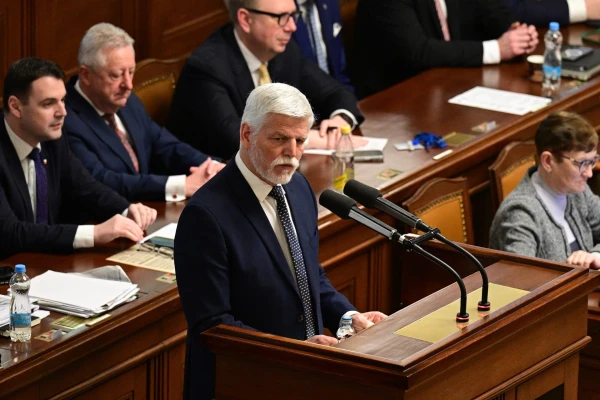
The president and the prime minister did not find common ground.
Prime Minister Andrej Babiš stated that the Czech Republic does not intend to increase military spending to 3.5% of GDP, as agreed by NATO countries. Moreover, the Czech Republic is at risk of not even reaching the level of 2% of GDP. According to analyst Jan Jireš, if this happens, the Czech Republic will essentially become the only NATO member country that is reducing defense investments in the context of a deteriorating security situation in the world and Europe.
Czech President Petr Pavel, in his address to lawmakers, stated that there is no justified reason for stagnation in defense and security spending today. He called the reduction or freezing of such expenditures a serious step and urged legislators to take responsibility. According to him, in the context of an unpredictable geopolitical situation and growing threats, strengthening defense is not preparation for war, but a way to ensure peace and the long-term sustainability of the country.
According to the updated government proposal, the Ministry of Defense budget this year will amount to 154.79 billion crowns (6.37 billion euros) – 21 billion less than the initial plan of Petr Fiala's cabinet. Total defense spending is expected to reach approximately 185 billion crowns (7.62 billion euros), which corresponds to 2.07% of GDP according to the January macro forecast. How will the budget cut affect the Czech Republic's ability to meet commitments made to alliance partners?
"This will have consequences on two levels. First, on the political, psychological level: if the Czech Republic really goes for these cuts, if they are approved by the Chamber of Deputies and then there is no additional increase in the defense budget within a year. If this happens, the Czech Republic will essentially become the only allied country, the only NATO member state that, in the current heightened security situation in the world and in Europe – a situation that continues to deteriorate and will deteriorate – is reducing its defense investments. This will be particularly noticeable in our region, where several countries, in fact all neighboring NATO member states, are increasing their defense spending, some even very rapidly. The Poles already reached about 4.5% of GDP last year, significantly exceeding the target that all allied countries, including the Czech Republic, committed to achieve last year – to reach 3.5% of GDP for defense in terms of military capability development and armed forces functioning by 2035."
According to Jan Jireš, the Baltic states, Scandinavian countries, as well as Germany are also rapidly increasing their defense spending.
"The Germans are well aware that we cannot risk our defense any further – we must invest in it as much as possible. Even countries that are, so to speak, close to Andrej Babiš and the current Czech government – Slovakia and Hungary – will confidently exceed the level of 2% of GDP for defense this year and intend to increase their spending in the coming years. Neither the Slovaks nor the Hungarians have in any way questioned the allied commitment of last year that I mentioned, and of course, Viktor Orbán would never question what he committed to at the NATO summit in The Hague and would not reduce defense spending. Thus, the Czech Republic will stand out from the general trend. If the cuts happen, then probably in the table of 31 allied countries (since Iceland has no army and is not counted) for 2026, the Czech Republic will be at the bottom. And, of course, when Donald Trump comes to the NATO summit in Ankara in July, and his advisors show him this table, highlighting problematic countries with a marker, the Czech Republic will stand out the most. And, of course, it will be interesting to see how Trump, as a representative of the most significant allied country, on whose shoulders the entire defense of the alliance essentially rests, will react to this."
In recent weeks, Czech media have reported that the American side has shown significant interest in this issue. It was reported that several negotiations took place between U.S. representatives and members of the Czech government, including Prime Minister Andrej Babiš. The position of the American side during this period was formulated quite clearly: it was considered unacceptable for the Czech Republic to be the only allied country to reduce defense spending. Furthermore, the discussion was not only about the political and symbolic aspect of the situation but also its practical consequences. It was noted that a 21 billion crown cut in the Ministry of Defense budget would effectively lead to freezing the modernization of the Czech army. Several projects would have to be suspended, postponed, rescheduled, or reduced.
According to Jireš, the reduction in defense spending undermines the position of Secretary General Mark Rutte, who bears joint responsibility for the European members of the alliance in the eyes of others, and also weakens the positions of other European leaders who are actively advocating and taking steps to strengthen defense capabilities.
"3.5% is Really Necessary to Strengthen Czech Defense"
During his visit to the United States, Foreign Minister Petr Mačinka attempted to negotiate an exemption for the Czech Republic from the obligation to allocate 2% of GDP for defense spending this year. Is such an exemption possible?
"No, of course, the situation is as follows: all these obligations are political in nature, meaning they are not legally binding. They are political declarations, and even pressure from allies for individual countries to fulfill these obligations is primarily political pressure. If we do not fulfill these obligations, we risk incurring certain costs: firstly, in terms of our defense capability, of course, but also in terms of our reputation, allied relations, respect from partners, and so on. So, we are not talking about legally enforceable obligations. And I can imagine that the government and Petr Mačinka may think that our key allies will turn a blind eye to this in exchange, for example, for a promise that in the future, Czech defense spending will be higher. One thing is ideological closeness, which the government can rely on, but on the other hand, the Trump administration has been and will be quite pragmatic on these issues, and the president considers it a priority to make Europeans finally take responsibility."
Recently, Defense Minister Jaromír Zuna stated that the country's security is not measured solely by the ratio of defense spending to GDP. The budget cuts proposed by Prime Minister Andrej Babiš's government, he said, will not jeopardize any of the army modernization projects.
"Let’s say these percentages are a kind of conditional designation. Of course, it is a simplification, to a certain extent a marketing or communication tool of NATO, but it is just a derived number. What really matters is building the military capabilities that the alliance needs to counter threats, to defend itself, and for collective defense to be credible and reliable. So, the main thing is for individual member countries to actually create the military capabilities that will collectively allow the alliance to defend itself or deter a potential aggressor. And how much money is needed for this is already a derived quantity. When I worked in the Ministry of Defense, we made calculations regarding the new allied commitments made at last year's NATO summit in The Hague. It turned out that to truly close all the gaps that have accumulated in Czech defense over the past 30 years due to long and serious underfunding, and at the same time to fulfill commitments to create new military capabilities, the Czech Republic needs to reach approximately 3.5% of GDP. So, on one hand, this number is a very rough and simplified tool, but in the case of the Czech Republic, it actually correlates with what needs to be done for our defense," summarizes analyst Jan Jireš from the CEVRO Institute and advisor to the Defense Industry Section of the Economic Chamber.








Leave a comment