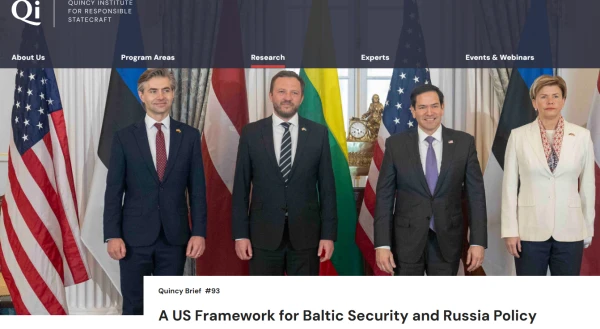
The Quincy Institute for Responsible Statecraft is an American think tank founded in 2019 and located in Washington, D.C. It is named after former U.S. President John Quincy Adams. It stands for realism and restraint in foreign policy.
Recently, the organization released an extensive document titled "U.S. Framework Program for Security in the Baltic States and Policy Towards Russia." In brief: the White House is recommended to reconsider its approach to allies.
"The Risk of Dangerous Confrontation..."
The Quincy Institute is considered a political hybrid, uniting "progressive left" Democrats and "libertarian paleoconservative" Republicans. It has been funded simultaneously by liberal George Soros and right-wing Charles Koch. Unlike other think tanks in the U.S., it does not accept donations from abroad. The "Quincyans" have objectively criticized both Trump and Biden. Currently, their focus is on our regions.
"The Baltic states, located in a vulnerable geographic position, adhering to a hardline political stance and largely dependent militarily on the United States and other Western allies, represent both a vulnerable point and a potential stronghold in the relations between NATO, America, and Russia," the briefing on quincyinst.org tells American readers.
According to analysts, allied countries now act as consumers of security: "The risk of dangerous confrontation in the Baltic region diverts limited resources and strategic attention from more important U.S. priorities: ensuring national security, addressing issues in the Western Hemisphere, and countering China — the only equal competitor to the U.S."
The United States is advised to "begin creating a truly inclusive European security architecture."
"Such an order would unite Ukraine and Russia within frameworks that would eliminate or at least significantly reduce the risk of a new major war on the continent. An inclusive security order that eliminates the war in Ukraine as an unhealed wound in Europe is ultimately the most stable foundation for strengthening the security of the Baltic states and aligns with the Trump administration's National Security Strategy."
De-escalation Needed
This term is applied to the military aspect, where slogans of both "deterrence" and "strategic defeat" of Russia currently dominate.
"The Baltic states pursue a hardline policy," the Quincy Institute states, "while other member states play along, prioritizing intra-alliance solidarity and the image of unity. This creates a self-reinforcing cycle in which radical positions dominate the discourse, while pragmatic voices remain sidelined."
"Although the traditional threat of a Russian invasion remains limited, the risks of escalation arising from the interaction of the hardline policies of the Baltic states, the resurgent Russian 'war party,' and the ongoing war in Ukraine are unacceptably high. The United States must reaffirm the guarantees provided by Article 5 of the North Atlantic Treaty, gradually shifting the burden of ensuring the security of the Baltic states and Europe as a whole onto European NATO members."
The strategic situation in the Baltics is characterized by:
-
Degradation of Russian conventional forces: the 11th Corps, stationed in Kaliningrad, has suffered heavy losses in the Ukrainian operation, for which recovery will take 5–10 years;
-
NATO's overwhelming dominance in Europe over Russia in terms of tactical aviation (10:1) and pilot training;
-
The transformation of the Baltic Sea into an internal lake of the North Atlantic Alliance, where the Russian fleet can be "quickly neutralized."
A "blitzkrieg" in the region is currently impossible due to the expanded presence of allied forces: "The combat groups of the national forces of the Baltic states and NATO's Enhanced Forward Presence (EFP) units are designed for retreat and defense of cities like Tallinn, Riga, and Vilnius, turning them into fortified bastions."
Maximalism is Becoming Tiresome
At the same time, the political image of the Baltics is causing fatigue in Brussels. The Quincy Institute relies here on the opinion of the memorandum's author, former European Parliament advisor Eldar Mamedov, who also worked at the Latvian embassy in the U.S.:
"In private, diplomats from the EU's largest member states are concerned about the inflexibility of the Baltic states on issues critical to developing a common strategic path. In debates about the use of frozen Russian assets or the accelerated accession of Ukraine to the EU, Baltic maximalism is increasingly seen not as principled resolve but as an obstacle to pragmatic solutions capable of preserving fragile consensus."
"Within the countries, restrictive policies towards Russian-speaking minorities in Latvia (35 percent of the population) and Estonia (27 percent) create long-term vulnerabilities," the institute from Washington touches on our ethnopolitics. "This shift, if not reversed or at least recalibrated, provides the Kremlin with levers to destabilize Baltic societies from within, undermining their long-term resilience and cohesion within NATO."
"The perceived security threat posed by the Russian-speaking population — often elderly, isolated, and lacking family ties to Russia — hardly corresponds to accepted norms. Such alienating policies have drawn criticism even from traditionally sympathetic international publications like The Economist."
Unacceptable Risk
The Trump administration is advised to exert "private pressure on the leaders of the Baltic states."
"The United States should privately urge the leaders of the Baltic states and other European nations with a belligerent stance to soften their escalatory rhetoric and policies. This includes using U.S. influence to block initiatives that pose an unacceptable risk of military confrontation between NATO and Russia — such as the mass seizure of Russian tankers, shooting down Russian aircraft, or blockading Kaliningrad — without explicit consent from the U.S. administration. This is not a retreat from leadership but a manifestation of it: maintaining ally unity through strategic discipline."
"While state-building and social transformation of other societies are not within the purview of the U.S. government, the marginalization of Russian-speaking minorities in Latvia and Estonia poses a clear long-term security threat. The United States should quietly support the recommendations of bodies like the Council of Europe, urging Latvia and Estonia to balance language promotion with minority rights. Promoting the integration of the Russian-speaking population is a crucial long-term security measure that deprives the Kremlin of a potential 'fifth column.'
…However, in the current situation in the Middle East, the U.S. will likely not focus on the Baltics for at least several months.