
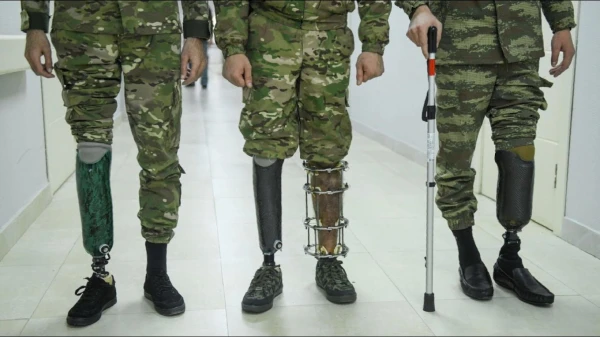
50% of Russians want to seek a solution through "peace negotiations."
Another wave of forced conscription in the spirit of September 2022 is not entirely excluded. But only as a Putin ultimatum directed at his subjects, informing them that "normalcy" will no longer be portrayed, writes Sergey Shelin, a social and economic analyst, in The Moscow Times.
Speculations about the resumption of forced conscription into the army have come back into fashion. They are widely discussed in media not controlled by Putin. The controlled media have also joined in and, of course, urge their audience "not to give in to emotions when reading unverified sources."
Timely Event
The political scale of this event, if it indeed occurs, is underestimated. The only wave of "partial mobilization" was proclaimed by the Russian government on September 21, 2022. Putin did not disclose the reasons for this decision to his subjects. He simply notified them.
Conscripts, students, and defense industry workers were exempted from conscription at that time. The clause of his decree regarding the number of conscripts was not published, but on the same day, the then Minister of Defense Shoigu informed the frightened public that there would not be too many of them, only 300,000.
The high relevance of that event for the Russian authorities was evident. The mobilization was organized due to two successful Ukrainian offensives – in the Kharkiv and Kherson regions.
The first, the most successful, was already coming to an end, the second was in full swing, and the impending withdrawal of Russians from Kherson seemed inevitable. Putin was not going to propose peace, and he had no other way to continue the war.
In these circumstances, forced conscription appeared almost self-evident. But it had two significant consequences.
Fear and Annexation
Firstly, a brief but irreversible panic swept across the country. The prospect of being sent to the front shocked Russians much more than the news of an attack on a neighboring country seven months earlier.
About half a million people fled abroad. And many more did everything to hide or somehow evade conscription. In four to five weeks, the regime fulfilled its conscription plan, but the confusion at that time remains the largest expression of mass disapproval throughout the years of the war.
It was during those mobilization days that another survey by Russian Field first showed that the number of supporters of "transition to peace negotiations" equaled the number of those who preferred "continuation of the special military operation (SMO)." Before that, the advantage of "continuers of the SMO" was one and a half times greater: 54% to 35%.
The second long-term consequence of the mobilization was the annexation of the Donetsk, Luhansk, Zaporizhzhia, and Kherson regions. Putin announced it (more precisely, the "referendums" in the occupied territories) on the same day as the conscription. This ostensibly justified the recruitment of soldiers: not because of defeats, but rather for the expansion of the empire.
All activities to formalize the "annexation" were completed within two weeks, and since then, the regime has portrayed the capture of the uncontrollable parts of these regions as the goal of the war.
Putin wants much more, but in the current negotiations with the Americans and Ukrainians, he has made the recognition of his then annexations an insurmountable problem. And this is also an echo of the "partial mobilization."
Victims Instead of "Normalcy"
The sad and burdensome experience of forced conscription forced the regime to establish other ways to replenish the army afterward. For three and a half years, most Russians have lived as if separately from the war, in an atmosphere of some kind of "normalcy."
Let us set aside the question of how genuine this "normalcy" is. But the very duration of it indicates that Putin has staked on it and will not abolish it without serious reasons.
A new wave of "partial mobilization" would mean dismantling this accustomed life. The residual domestic freedoms of Russians would have to come to an end.
To prevent potential conscripts from attempting to flee, it will be necessary to close the borders in one way or another. And it is unlikely that this time all the categories exempt from conscription will be spared as they were last time. Defense industry workers will not be touched, but others, especially students, who have long irritated the authorities with their numbers, will begin to be swept up.
This means that those who work for the war will become a protected group from troubles, and the struggle to be included in the list of those equated with them will become the most important activity. And the freedom to work anywhere, which is still real today, will turn into an abstraction.
The loss of personnel in civilian sectors will reduce both the quantity and quality of the services and goods they produce. And this will translate not only into rising prices. The mobilization aura will begin to envelop more and more areas of everyday life.
These sacrifices and deprivations will need to be given meaningful form and at least slightly justified in the eyes of the subjects. Simply repeating tales about the eternal battle for four unoccupied regions will not be enough. Putin will have to update the goals of the war, and moreover, in the direction of even greater aggressiveness and inadequacy, waving aside even the games with Trump.
An Unattractive Step
And such an imposition of militarism would occur against the widespread desire in Russia for the war to end. The most recent survey by Russian Field shows that, unlike in 2022, now only a minority advocates "continuing the SMO."
Only 37% remain in favor of that, while 50% want to seek a solution through "peace negotiations." Ultimately, Russians will always submit to the authorities. But overcoming their discontent in the fifth year of the war will require additional efforts, and Putin knows this.
Such a significant step towards turning his possessions into a military camp is unlikely to be attractive for him. Putin wants to rule for several more decades and loves stability. The "normalcy" of Russian life is a plus for him. He will abandon it only if he cannot achieve his goals by other means.
The Institute for the Study of War (ISW), proving the proximity of mobilization, refers to the fact that the influx of contract soldiers has ceased to cover combat losses. Unnamed sources from Bloomberg report that in January 2026, the outflow exceeded their influx by 9,000. But such leaks have occurred before and were not confirmed later.
According to independent estimates, in 2024 and 2025, 400,000 to 407,000 contract soldiers were recruited into the army. The assumptions that last year the influx of mercenaries decreased by about thirty thousand compared to the year before are based on confusing and not necessarily accurate statements by Dmitry Medvedev.
Fluctuations from month to month can be large, but overall, the recruitment of new personnel apparently compensates for losses (estimated at about 35,000 killed and wounded monthly in 2025). At least, that was the case until recently.
With Growing Ingenuity
The costs of attracting mercenaries have not become an unbearable burden for the Russian treasury. In 2025, bonuses for signing contracts amounted to about 0.8 trillion rubles. This is only one-fifth to one-sixth of total Russian expenditures on manpower (4 trillion – 5 trillion), the main items of which are monetary allowances and burial benefits.
The savings from switching from contract soldiers to conscripts are therefore not critically important. When there are fewer mercenaries than needed, the authorities arrange another round of bonus increases, which is apparently what is happening now. And if regional budgets do not have enough money for this, the federal budget will supplement them. Siluanov is used to it.
This does not change the fact that the pool of Russians willing to voluntarily enlist to fight is dwindling.
However, the regime's ingenuity is growing. It is smoothly transitioning to forced and semi-forced recruitment of soldiers through various partial and local measures that do not irritate the public as much as mobilization does.
Here are a couple of fresh examples. At the Higher School of Economics, students who failed their exams are handed a notice:
There is an alternative to expulsion – the opportunity to sign a special contract with the Ministry of Defense of the Russian Federation for a period of 1 year on a voluntary basis. During the term of the contract, you will be granted an academic leave, after which you can continue your studies. Please inform us of your decision within three days. During this period, your expulsion will be suspended.
And in other universities, even more creative flyers are being distributed, enticing service "20 km from the combat zone," promising "work not on the front line" and guaranteeing "reduced risk of coming under enemy fire associated with performing combat tasks away from the line of direct contact with the enemy."






Leave a comment