
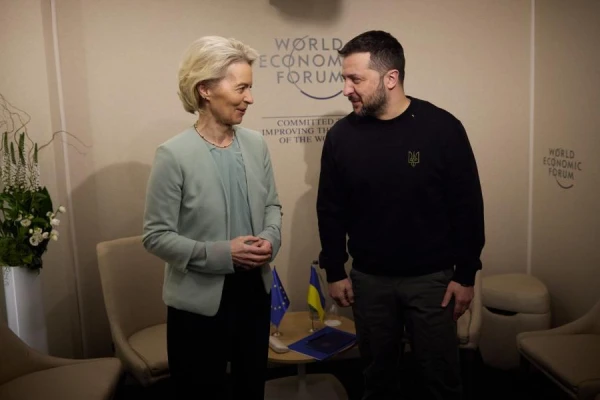
EU member states did not support the proposal to revise the accession rules to provide Ukraine with partial membership – without voting rights and other benefits.
European Union countries have generally rejected the idea of granting Ukraine so-called 'reverse' membership as part of ongoing peace negotiations, fearing that such a reform would undermine trust in the accession process.
Skepticism became evident on Wednesday evening during an informal dinner of ambassadors with representatives of the European Commission, several diplomats told Euronews.
"The idea of this dinner was to bring the discussion back to political realism," one of them said on condition of anonymity. "Our priority is to firmly anchor Ukraine in Europe, but to do so with real steps."
Now, according to him, "we need other options and other conditions."
Under the 'reversal' model proposed by the Commission, Ukraine would become a formal member of the EU but without access to most accompanying benefits – such as the right to vote, the Common Agricultural Policy (CAP), and regional cohesion funds.
These benefits would be granted gradually, as progress is made and Kyiv meets the necessary criteria. Essentially, the trajectory of accession would be 'reversed'.
The Commission has yet to outline this radical proposal in writing. Instead, its main contours have been discussed with member states and leaked to the press.
However, on Wednesday, ambassadors received this concept with considerable skepticism, and the lack of enthusiasm in the room indicated that the idea is unlikely to gain traction.
Such a reaction was quite expected: capitals had already indicated that they would oppose a reorganization that would radically change the very nature of the accession process.
Another diplomat criticized the Commission for raising a fuss and creating the 'illusion' that enlargement could be purely political rather than based on 'merit'.
According to participants, the exchange of views was open, candid, and friendly, but it was overshadowed by the fact that a peace agreement remains distant: Russia has yet to make concessions at the negotiating table.
Diplomats emphasize that neither Washington nor Moscow can dictate the pace of accession, which is determined by the European Commission and member states.
2027 in Doubt
However, the dinner on Wednesday is unlikely to be the last word in this discussion.
Ambassadors agreed that discussions need to continue in the coming months to find a balance between Ukraine's aspiration to join the bloc and the necessity of maintaining the stability of the union and the integrity of the accession process. It consists of 35 complex negotiation chapters, the closure of which could take years.
Montenegro – the most advanced candidate country – began negotiations back in June 2012. For Ukraine – the first country to apply for membership while at war – such a long wait is considered unacceptable.
Volodymyr Zelensky insists that a 'clear date' be fixed in any future peace agreement, with 2027 being mentioned as a possible benchmark. A specific roadmap for EU accession could partially compensate for painful territorial concessions and facilitate gaining necessary public support in a membership referendum.
"We really want to accelerate the EU accession process," Zelensky said last week, warning that Moscow would try to divide member states and disrupt the necessary consensus.
European Commission President Ursula von der Leyen, speaking alongside Zelensky, praised the 'outstanding' speed of reforms in Kyiv but warned against attempts to rigidly fix a date for accession.
"The date you set is a target you strive for. But you know that from our side, such dates are impossible in themselves," she said.
According to diplomats, von der Leyen's statements reflect her growing understanding of the doubts that member states express privately.
However, skepticism is also manifesting publicly. Earlier this week, new Dutch Prime Minister Rob Jetten urged Brussels to exercise 'caution' regarding enlargement.
"We are open to considering broader support for these candidate countries, but too rapid enlargement is not the way to go," Jetten told reporters.
"I think it is currently impossible to name a date for Ukraine's accession. But we can continue the dialogue – and I intend to discuss this with President Zelensky – about how Europeans can support Ukraine in carrying out important reforms. However, at this stage, it is too early to talk about timelines.



Leave a comment