They are usually recruited online through TikTok and similar platforms.
At least 55 citizens of Ghana have been killed during the fighting in Ukraine, said the Minister of Foreign Affairs of the West African country, Samuel Okudzeto Ablakwa. He promised to fight against illegal schemes of recruiting Africans by Russia.
Ablakwa visited Kyiv to discuss the fate of two Ghanaian citizens captured by Ukrainian military forces. During the visit, Ukrainian authorities, citing their own intelligence data, provided statistics on Africans recruited by Russia for combat. "They documented 1,780 Africans from 36 countries who were lured by criminal human trafficking networks to participate in the war against Ukraine," the minister reported on social media.
According to him, the situation with Ghanaian citizens is particularly alarming. Since 2022, it is believed that 272 residents of the country have gone to the front. According to available estimates, 55 of them have died, and two are being held as prisoners of war.
... Caroline Mukiza wipes away her tears. The 42-year-old Ugandan is kneeling on a bench in a church on the outskirts of Uganda's capital, Kampala. Just a few days ago, she learned from social media that her husband had died in the war in Ukraine.
Her husband, 46-year-old Edson Kamwesigye, had previously worked as a security guard in Iraq and Afghanistan, Mukiza explains as she walks through a garden at the church after prayer. In December, she says, her husband flew to Moscow for a new job as a security guard, and there had been no news from him for a long time. "On January 15, 2026, he wrote: 'Guys, I need your prayers. We were forced to sign contracts with the army,'" the woman shares. Her husband reported that he had undergone a short training course and was now heading to the front lines to participate in combat.
Tears flow down Mukiza's cheeks again. She sits on a bench in the shade behind a stone building with colorful stained glass windows. Quietly sobbing, she recounts how, at the end of January, acquaintances asked her if she could confirm that photographs of her deceased husband were circulating online. "I asked people not to send me those photos," the woman continues, looking towards the cemetery near the church.
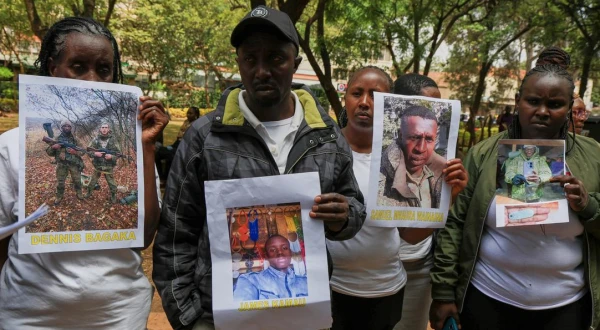
Ugandan Mukiza is not the only one in such a situation. In Uganda, Kenya, Cameroon, Nigeria, and South Africa - in all these countries, it has been reported that local men were recruited allegedly for work in Russia and then sent to the front as part of Russian forces.
"At least 1,436 citizens from 36 African countries are currently fighting in the ranks of the Russian army that invaded Ukraine," said Ukrainian Foreign Minister Andriy Sybiga last November, informing the authorities of African states about the possible deaths of their citizens on the front lines. "Signing a contract is tantamount to signing a death warrant," he warned. According to the minister, most Africans "will not survive a month" fighting in the ranks of the Russian army.
The fact that young Africans have been deliberately recruited to participate in the war in Ukraine has long been no secret. Back in May 2024, Ukrainian military intelligence published a statement on its website claiming that Russian authorities were sending Africans to the front lines as mercenaries, paying them $2,200 a month.
However, little was known about the methods of recruitment, the fate of these individuals, and even the scale of the operation. The statements of the Ukrainian Foreign Minister in November, quoted by African media, triggered a chain reaction. Members of many families turned to the police searching for their missing sons and husbands, who, they said, had gone to Russia. Since then, more and more videos and photographs of Africans participating in combat have appeared on social media. In one video, filmed on a mobile phone at the front in Ukraine, about a dozen African mercenaries can be seen sitting in the snow, singing or dancing to a song that was performed during the civil war in Uganda in the 1980s.
In another video released by the Armed Forces of Ukraine, Ugandan Richard Akantorana explains in early January that he had hoped to get a job in a supermarket. According to him, upon arriving in Moscow, he was told: "You will join the ranks of the Russian army." "When we refused, they held a gun to my head and forced me to sign documents," Akantorana claimed. He then stated that he was stationed near Donetsk, and during his first battle, he surrendered to Ukrainian forces. "My dear compatriots in Africa. I warn you - do not fall into this trap," the Ugandan urged his fellow countrymen.
For 316 Africans, it seems, this warning came too late. The names of the deceased soldiers, whose bodies were discovered by Ukrainian military forces on the front line, are included in a 15-page list published by INPACT - a research platform created by the German broadcaster ARD. Most of the victims - about 100 people - are Cameroonians. The list also includes two citizens of Uganda. Mukiza's husband's name is not among them.
Some videos circulating online raise suspicions among observers that Africans on the front are being used as "cannon fodder." In one of them, an African mercenary is filmed in an underground bunker with a large mine attached to his waist. "Stop panicking," a voice in Russian can be heard in the background. A rifle barrel is pointed at the African: "Now run - today you will go first." It is impossible to determine how authentic this video is.
Meanwhile, the INPACT report states: "Most Africans on the front are assigned the role of 'cannon fodder.' Russia exploits their ambitions and desperation to replenish its army ranks in Ukraine."
In August of last year, nine people were detained at Entebbe International Airport in Uganda on their way to Moscow. They confirmed that they had been hired to work as security guards. Two days later, a Russian was arrested in the Ugandan capital, Kampala, who claimed to work for the recruitment agency "Magnit."
Investigators later established that "Magnit" was not registered in Uganda. Meanwhile, many international recruitment agencies operate in the country, most of which seek cheap labor for work in the UAE, Saudi Arabia, or Qatar. Young women are hired as domestic workers for wealthy locals, while men are employed as drivers or security personnel. Uganda has corresponding agreements with these countries.
"We have not made such arrangements with Russia," clarifies Joshua Kyalimpa, press secretary of the Ministry of Labour, Gender, and Social Development of Uganda. In response to a DW inquiry, he explained: "There are cases of Ugandans participating in this conflict (the war between Russia and Ukraine). But they are usually recruited online through TikTok and similar platforms. Our ministry considers it its duty to warn Ugandan citizens against recruitment as supposedly labor migrants to work in conflict zones in Russia or Ukraine."
Caroline Mukiza contacted the Russian embassy in Kampala, sending a letter asking for help in locating her husband's body so that the family could bury him "according to our culture and family traditions." According to Mukiza, no response has yet come. It is unlikely that the woman will receive help from her country's authorities either. The head of the Ugandan Foreign Ministry, Okello Oryem, stated in an interview with a local television channel NTV: "Uganda does not have the capacity to bring back the bodies of those who died abroad."
"I am in despair," Mukiza sighs, who has not yet told her two children about their father's death. The woman fears their questions because the children know that when someone dies, they must be buried. "They will ask me where dad is," Mukiza quietly says and cries again, burying her face in a handkerchief.