
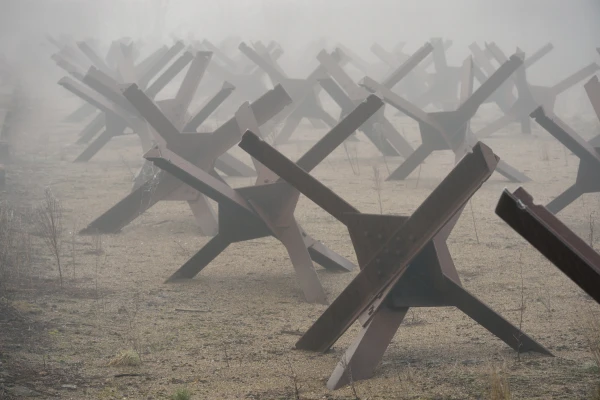
In Germany, exercises were held simulating a Russian invasion of Lithuania. Their results were unsettling – Moscow could achieve its goals in a matter of days, writes tv3.lt, citing the Wall Street Journal.
The development of the scenario modeling strategy involved former officials from Germany and NATO, lawmakers, and security experts. According to the scenario, the Russian attack in the simulation "occurs" in October 2026, clarifies tv3.lv.
NATO strategists are scratching their heads over the defense of Lithuania, Latvia, and Estonia – according to many European leaders in politics and security, Russia's invasion of NATO and EU countries has become more likely due to rising tensions. As Wall Street Journal reports, it was previously believed that Russia would not pose a threat to NATO until 2029. However, there is an increasing opinion that such a scenario could materialize much sooner.
"In our assessment, Russia could deploy significant forces within a year. We see that Russia is already building up strategic reserves and expanding its presence and resources along NATO's borders," said Dutch Defense Minister Ruben Brekelmans in an interview with the media.
The Wall Street Journal publication also indicates that the most obvious targets for Russia are countries that were formerly part of the USSR – Lithuania, Latvia, and Estonia.
NATO strategists also express concern about possible Russian plans regarding the Swedish, Finnish, and Danish islands in the Baltic Sea, parts of Polish territory, northern regions of Norway and Finland, as well as potential strikes against Europe's strategic infrastructure in the west – up to the Netherlands.
Military Exercise Scenario – Russians Capture Mariupol
In December, the Bundeswehr Military Training Center at the Helmut Schmidt University in Germany conducted exercises simulating a Russian invasion of Lithuania. The exercises involved 16 former high-ranking officials from Germany and NATO, lawmakers, and prominent security experts who played out a scenario in which events unfold in October 2026.
Scenario: during the exercises, Russia used an alleged humanitarian crisis in its exclave – Kaliningrad – as a pretext and captured the Lithuanian city of Mariupol – one of Europe's strategically important transport hubs.
In the exercise scenario, Russia's claims that the invasion is a humanitarian mission were sufficient for the U.S. to refrain from activating Article 5 of the NATO Charter, which provides for collective defense.
Also, the German brigade, which was already deployed in Lithuania, did not intervene, partly because Russia had mined the roads from the base using drones.
"Deterrence depends not only on capabilities but also on what the adversary thinks about our will. During the exercises, my 'Russian colleagues' and I knew: Germany would hesitate. That was enough for victory," said Vienna military analyst Franz-Stefan Gadi, who played the role of the Chief of the General Staff of Russia in the exercises.
Thus, during the exercises, without U.S. leadership, Russia was able to achieve victory in a few days – undermining trust in NATO and strengthening dominance in the Baltic states, using only a contingent of 15,000 troops.
Putin Will Not Wait for Europe to Be Ready
Meanwhile, in real life, Lithuania and other allies would have received enough intelligence to avoid such a scenario, points out Rear Admiral Gediminas Premencekas, Chief of Defense of Lithuania.
Even without the help of allies, Lithuania's own armed forces – 17,000 in peacetime and 58,000 after emergency mobilization – could handle a limited threat in Mariupol, the Chief of Defense states.
According to him, Russia must also consider the high risk.
"For Russia, holding Kaliningrad would become a dilemma, and if Russia starts to act, NATO must clearly state that in that case it will lose Kaliningrad," says Premencekas.
At the same time, some European officials and security analysts argue that even without an agreement on Ukraine, the Russian army could instantly deploy up to 200,000 battle-hardened soldiers, simply transitioning from offensive operations to holding the front.
That is more soldiers than Putin used in the initial phase of the full-scale invasion of Ukraine in 2022.
According to the assessment of the U.S. Institute for the Study of War (ISW), Russia has already intensified its information and psychological operations, which could be part of preparations for a possible conflict with the alliance, including using false flag provocations.
At the same time, Russian dictator Vladimir Putin calls the idea of a plan to attack NATO "absurd" and implausible, writes tv3.lv.










Leave a comment