
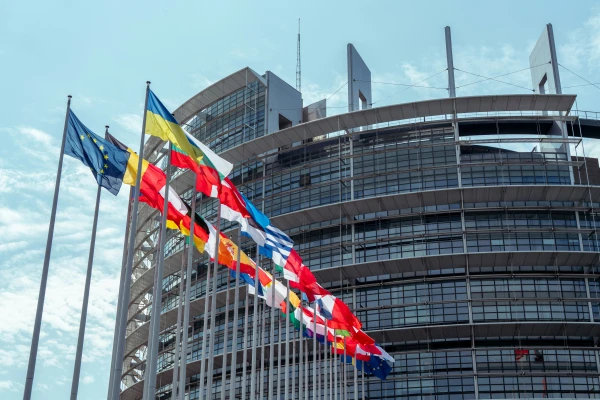
Former President of the European Central Bank Mario Draghi: "The world order that has existed until now no longer exists"
Former President of the European Central Bank Mario Draghi urged EU countries to create a full-fledged federation to confront a world where the main players — primarily the United States — no longer adhere to the previous rules of the game in politics and economics. Draghi had already warned about the risks of Europe's lagging behind in his 2024 competitiveness report, yet less than 10% of his recommendations were implemented. Today, he insists on a radical deepening of integration.
"But the threat lies not in its collapse itself, but in what will replace it," the economist is quoted by International French Radio. According to Mario Draghi, the architecture of the European Union was originally built on the belief that "the supremacy of international law, supported by reliable institutions, promotes peace and prosperity." Lacking sufficient means to ensure their own security, European states relied on the United States, and "always in alliance with Washington could counter any threat and maintain peace in Europe." This security system, combined with trade within the allied space, allowed Europe to make "an open economic model based on open markets the foundation of its prosperity and international influence."
The economist emphasizes that the previous world order was not a mistake. "It brought real benefits and was advantageous for many": the United States gained hegemonic status and "the privilege of issuing the world's reserve currency," Europe — "deep trade integration and unprecedented stability," and developing countries — participation in the global economy, allowing "billions of people to escape poverty." Its collapse, according to Draghi, is explained by the fact that the system "failed to correct its own imbalances."
A turning point in the development of the system was China's accession to the WTO. "With China's entry into the WTO, countries began to prioritize economic benefits, ignoring security considerations," Draghi states.
The danger, according to Draghi, is related to the new strategic context. The United States, he noted, is focusing on what it had to give up under the previous world order, not mentioning the benefits it provided, imposing tariffs against Europe and for the first time openly indicating that the political fragmentation of the European Union serves its interests. At the same time, China controls critically important links in global supply chains and is ready to use this as a tool of influence.
As a result, Draghi warns, a scenario is forming where "Europe risks becoming simultaneously subordinate, fragmented, and deindustrialized." He makes a harsh conclusion: "Europe, unable to defend its interests, will not be able to maintain its values for long." The transition period, according to Draghi, will be prolonged. "Dependencies will persist, even if competition intensifies," he noted. Europe, in his assessment, remains heavily dependent on the United States in the fields of energy, technology, and defense, while China provides over 90% of rare earth element imports and dominates key green transition supply chains.
In these conditions, the EU, Draghi emphasized, acts rationally: it concludes agreements with partners "sharing our mindset" and strengthens its positions where it already plays an irreplaceable role.
However, he underscores: "This is a strategy of holding positions, not an end in itself." Taken individually, most EU states, according to Draghi, "are not even sustainable middle powers." The strength of Europe, he emphasized, lies in its aggregate — in the scale of the European Union, its economic and demographic weight, political culture, and 75 years of institutional building of the European project.
The central element of Draghi's argument is institutional:
"The unification of small countries does not automatically create a powerful bloc. There is a name for this: confederation." The confederal logic still operates in Europe regarding the defense sector, foreign and fiscal policy. In these areas, Draghi noted, "each state retains the right of veto and cannot withstand pressure alone."
Where Europe has already federalized — in trade, competition policy, the single market, and the monetary sphere — it is perceived as a united force and acts from common positions.
This defines Mario Draghi's central thesis: "To become a power, Europe must transition from confederation to federation."
He calls this path "pragmatic federalism" — an approach where actions are taken where they are already possible, with ready partners, but with a clear goal of creating institutions "that have the real ability to make decisions and act under any circumstances." At the same time, Draghi emphasizes, "unity does not precede action; it is formed through joint decisions and the solidarity they create."
Mario Draghi's speech is a new signal that Europe is seriously rethinking its place in a changed world. The day before, European Commission Vice President Stéphane Séjourné published an address signed by the leaders of over 1,100 large European companies, calling for "European preference" in the distribution of procurement and orders in strategic industries. On February 12, at an informal summit in Belgium, EU leaders will discuss issues of competitiveness and strategic autonomy.
The figures explain the reasons for concern. The EU is the world's largest trading player and the primary partner of over 70 countries, controlling, for example, 100% of advanced chip manufacturing equipment, half of the commercial aircraft market. However, Europe's dependency is equally vast: on the United States — in energy, technology, and defense, on China — 90% in rare earth elements and green transition technologies. It is this combination of economic power and strategic vulnerability that elevates the question of possible federalization from ideological debates to a level significant for the survival of the European Union as a whole.





Leave a comment