The Revolution and the War of Independence hold a special place in the national myth.
In 2026, it will be 250 years since the creation of the United States. The holiday will be celebrated amid growing economic problems and political division, including differing views on the past. However, as noted by Moscow expert Maxim Cherkashin, Independence Day continues to unite the majority of Americans.
Americans cherish their history as much as they are poorly informed about it. On one hand, the country’s past is an important point of assembly for national identity and a key component of the prevailing civil religion. On the other hand, largely due to this same religious attitude towards their own history, knowledge of it beyond a certain set of dogmas learned in high school remains the domain of a rather narrow circle of citizens. The average American's understanding of the country's history boils down to a chain of events: the landing of the Pilgrims in Massachusetts, the War of Independence, the Civil War, World War II. The gaps between them comfortably remain unfilled.
A Nonpartisan Holiday
The Revolution and the War of Independence hold a special place in this chain. Although Independence Day became a federal holiday only in 1938, states began celebrating it even before the war with the British ended. The era quickly gave rise to a national epic: the Boston Tea Party, the signing of the Declaration of Independence, Paul Revere announcing the arrival of British troops—these and other moments served as sources of inspiration for artists, publicists, and politicians throughout the 19th century. The victors of the War of Independence laid the framework for the American constitutional system, which has survived without significant changes to this day, making July 4 important not only as a national holiday but also as a foundation legitimizing the political regime that arose from the events of July 4, 1776. The Founding Fathers led the country to victory and granted it a Constitution, through which the country gained wealth and prosperity. If reality turns out to be more complex and nuanced than this narrative, then so much the worse for reality.
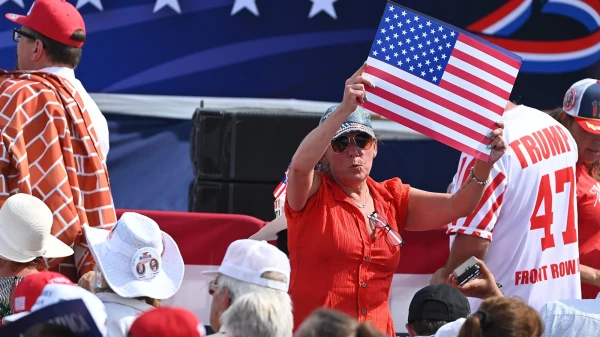
In our time, despite the escalating party polarization, the holiday continues to unite the nation: it is celebrated by the overwhelming majority of Americans regardless of party affiliation. But for citizens, it is primarily an occasion to gather with family for barbecues and fireworks, rather than a time for reflection on the history and fate of the nation. Democrats, with their attempts to view the past differently, such as in the spirit of the "1619 Project," have not been able to convince the majority of their voters that July 4 should be a day of mourning for the victims of racism. But Republicans have also failed to privatize the symbolism of the holiday, which stubbornly remains a national American celebration.
The President at the Anniversary
In anniversary years, Independence Day is celebrated in a special way. In 1876, the centennial of the U.S. coincided with the World’s Fair in Philadelphia, where many groundbreaking inventions were showcased for the first time. In 1976, the organization was more chaotic due to political disagreements—three years earlier, Congress had dissolved the commission responsible for preparing the celebration. As a result, most of the preparations fell to the states, and the holiday was remembered for an enormous amount of advertising and the visit of the English royal couple—which is particularly strange considering that independence from Britain was being celebrated. Planning for the next anniversary traditionally began early, with a nonpartisan commission formed in Congress in 2016; however, the Trump administration deemed this insufficient and created its own commission within the executive branch. So far, there has been no information about conflicts between the commissions, but as the holiday approaches, they are likely to arise and, like everything else, become fodder for mutual party accusations.
Yet one of the main intrigues of July 2026 will be economic: how much will it cost Americans to gather with their families for a barbecue? Official inflation, although reduced compared to the peaks of 2021-2022, remains high, around 3% per year. Price increases for many categories of food exceed the average price growth, and the term "cost of living crisis" has already become a common description of the situation. Donald Trump, whose victory in the 2024 elections is largely linked to citizens' dissatisfaction with high inflation, has essentially declared the problem nonexistent. The irony of the situation is that the Biden administration's reaction to rising prices in 2024 was exactly the same, for which it was fiercely criticized by Republican presidential candidate Trump. Given that the increased tariffs imposed by the sitting president, which are mainly paid by American importers, and the deportations of illegal immigrants, which have hit seasonal workers in rural areas, are not going to be canceled, prices for food and basic consumer goods will continue to rise—or demand will fall, and the real economy will find itself in recession.
Unlike the formal structure of the political system enshrined in the U.S. Constitution, the content of the social contract has necessarily changed throughout the history of the state. The latest iteration, which took shape during Ronald Reagan's presidency, can be simplistically characterized as "American elites spend as much as they want on credit, and in return, voters receive cheap food and consumer goods." Both Biden's Democrats and Trump's Republicans have found themselves unable in recent years to fulfill their obligations under this contract, while both continued to spend. The question is whether one of the parties can convince Americans that it is the one that will repay the debt of the social contract or propose a new agreement with society that voters will find appealing. If the former is unlikely due to changed fundamental characteristics of the global economy, the latter is hypothetically still possible: in some sense, Trump's use of Reagan's slogan—"Make America Great Again"—refers not only to restoring the social contract but also to formulating a new one. After all, the U.S. is a country of Protestant habits, and everything new must be sold as well-forgotten old. The problem is that Trump's Republican Party has not been able to overcome the cult of personality surrounding its leader, who, in turn, has become a successful politician but has not yet managed to become a statesman.
Ultimately, the anniversary year will not bring fundamental changes to America. Most likely, in the fall of 2026, voters in the midterm elections for Congress will vote against inflation, Democrats will take this as their well-deserved victory, and will stop trying to change anything. In that case, the political cycle will restart, accompanied by heated debates about the significance of the country's anniversary.