
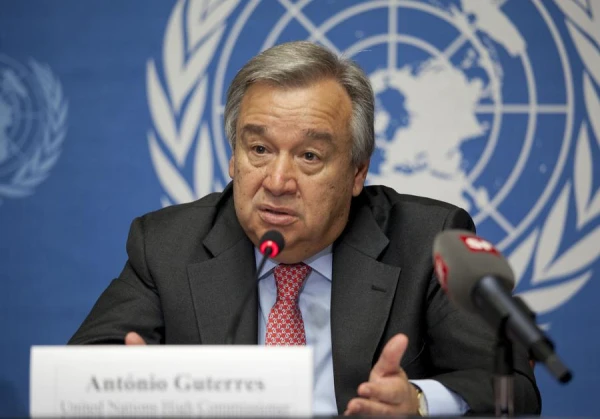
World leaders have been urged to prioritize correctly and invest in development rather than destruction as they enter 2026.
The head of the UN made an urgent call to protect the planet ahead of the New Year, warning that "chaos and uncertainty reign around us."
Secretary-General António Guterres stated that "one fact speaks louder than words," reporting that global military spending reached a staggering $2.7 trillion (about €2.3 trillion) last year. As humanitarian crises and political tensions escalate, these expenditures are projected to more than double, reaching $6.6 trillion (€5.63 trillion) by 2035.
"It is clear that the world has the resources to improve people's lives, heal the planet, and ensure a future of peace and justice," Guterres said.
"In 2026, I appeal to all leaders: take this seriously. Choose people and the planet over pain. This New Year, let us rise together: for justice. For humanity. For peace."
What Could Be Done Without Military Spending
In September, at the request of UN member states, Guterres presented a report titled "The True Cost of Peace," which highlights the "sharp imbalance" in global spending. It emphasizes the compromises that must be made due to the rising costs of armed forces and argues that investments in peace are more important than ever.
The report states that redirecting just 15% of global military spending is more than enough to cover annual costs for climate change adaptation in developing countries. It also notes that every dollar spent on military needs generates more than twice the greenhouse gas emissions compared to a dollar invested in civilian sectors.
Military spending of $1 billion (€852 million) creates about 11,200 jobs, but the same amount could provide 16,800 jobs in the clean energy sector, 26,700 jobs in education, or 17,200 in healthcare.
Less than 4% of the $2.7 trillion would be needed annually to end global hunger by 2030, and just over 10% would fully vaccinate every child on the planet.
The Cost of "Conflict Carbon"
War is often referred to as one of the "main polluters" of the planet: emissions arise not only from fuel-consuming planes and tanks but also from the clearing and restoration work following wars.
According to The War On Climate, a campaign advocating for the inclusion of military emissions in global climate agreements, the war between Israel and Gaza produced 32.2 million tons of CO₂ equivalent in just 15 months.
A 2022 study by Scientists for Global Responsibility and the Conflict and Environment Observatory estimates that the military accounts for about 5.5% of global greenhouse gas emissions, with armed conflicts emitting more CO₂ than most countries.
Despite this, armies are largely excluded from mandatory reporting under global climate agreements. Moreover, the EU leaves about 82% of its military emissions undisclosed and plans to increase defense spending by €100 billion by 2027.
This is why there has been a growing demand in recent years for the environmental cost of conflicts to be disclosed. "Europe cannot claim climate leadership while its military emissions remain opaque," says Dr. Soroush Abolfathi, a lecturer at the University of Warwick and a participant in The War on Climate.
Climate Reparations for War
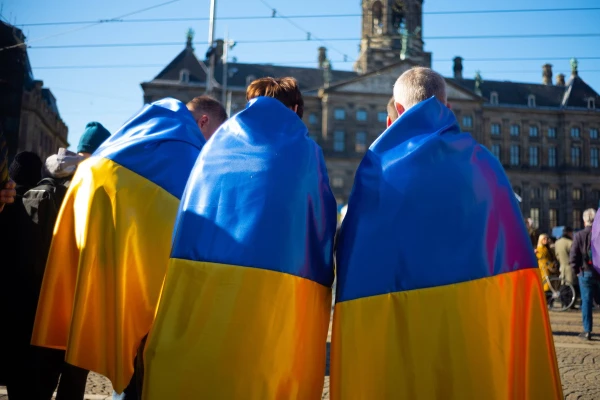
As of November, it was reported that Russia's invasion of Ukraine has so far led to emissions equivalent to 236.8 million tons of CO₂.
About 3 million hectares of Ukrainian forests have also been destroyed or damaged by the war, reducing their capacity to absorb greenhouse gases by 1.7 million tons per year. While Ukraine occupies less than 6% of the continent's area, it is home to a third of European biodiversity.
The Initiative for the Accounting of War Greenhouse Gases (IGGAW) has established that military forces on both sides have consumed 18 million tons of fuel and set fire to 1.3 million hectares of fields and forests.
Hundreds of oil and gas facilities have also been destroyed, and "huge amounts" of steel and cement have been ordered to strengthen the front lines. These emissions are comparable to the annual emissions of Austria, Hungary, the Czech Republic, and Slovakia combined.
Russia is currently facing pressure to pay $43.8 billion (approximately €37.74 billion), which could become the world's first case of climate reparations for war.






Leave a comment