

This is a 'hybrid attack' on the West, carried out with the approval of Belarusian dictator Alexander Lukashenko.
Russia has begun launching numerous balloons with contraband from the territory of Belarus, equipped with GPS trackers, which are then smuggled across the border into Lithuania. As reported by The Telegraph, this creates chaos in air traffic and represents a new phase in Russia's hybrid war against Europe.
Since October, the second largest airport in the Baltics, Vilnius, has been forced to close nine times due to an influx of balloons. Over the past year, Lithuanian authorities have intercepted at least 550 balloons, although the true number of launches is likely much higher; according to the Baltic news agency Belsat, only about 28% of the balloons are shot down.
"Lithuanian officials told The Telegraph that the swarms of balloons constitute a 'hybrid attack' on the West, carried out with the approval of Belarusian dictator Alexander Lukashenko... They also warned that the balloon launches pose a 'serious' threat to NATO's security on its eastern flank and are 'conducted in the broader context of Russia's aggressive war against Ukraine,'" the article states.
While balloons typically carry contraband, Lithuanian experts argue that in the future they could be equipped with spy cameras, incendiary devices, or explosives.
Even more concerning, they emphasize, is that the balloons help Russia map vulnerabilities on NATO's eastern flank every time they manage to cross the border.
The problem is that since balloons can reach altitudes of 8,800 meters, they are often too high to be targeted by drones or firearms. Additionally, there is a risk that the payload of a balloon, which can weigh up to 50 kg, could kill or injure people upon falling to the ground.
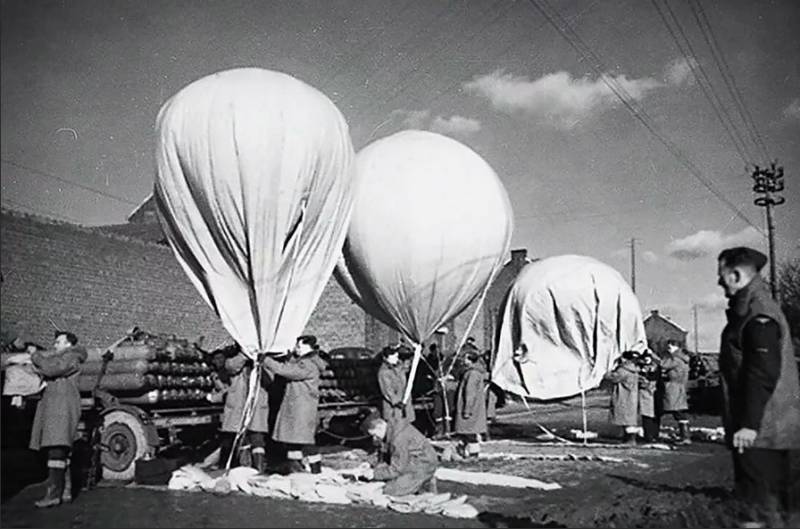
Meanwhile, the Soviet Union engaged in a battle with balloons on a much larger scale. Some of these balloons penetrated more than 1,500 kilometers from the Soviet border into the territory. According to Russian archives, a total of 4,112 balloons were detected over the territory of the Soviet Union from 1956 to 1977, of which only 793 were shot down by fighters. While some of these balloons belonged to civilian research organizations, most were predictably used for military purposes.
The peak of spy balloon activity occurred in January and February 1956, when nearly 2,000 balloons were launched. After that, they were observed much less frequently, except for short periods of increased intensity. Many years later, in December 1980 and January 1981, the Soviet air defense system recorded the presence of several hundred balloons. Despite their simplicity, a balloon is capable of much. For example, it can take air samples over specific sites. Nuclear facilities and test sites in the Soviet Union were of particular interest.
During one sampling period, from August 11 to September 14, 1975, 11 drifting balloons were detected over Soviet territory at altitudes of 10,000 to 15,000 meters. They were attacked by interceptors of the Soviet air defense forces, including MiG-19, MiG-21, Tu-128, Su-15TM, and Yak-28P fighters. Sometimes an entire squadron of 12 aircraft would engage a single balloon. Of these 11 balloons, 8 were shot down.
In two cases, it was established that although the balloon was not shot down, the equipment carried by the balloons was destroyed. Another balloon was not damaged. The average ammunition expenditure was high: 1.4 air-to-air missiles, 26 unguided rockets, and 112 cannon shells per balloon. In principle, the expenditure is not so deadly, but when the figures are multiplied by hundreds of launched balloons, it becomes clear that the war was quite fierce.
When balloons practically flooded the airspace of the USSR, it was only natural that the government began to take urgent measures.
In a rapid pace, the anti-aircraft missiles of the S-25 "Berkut" and S-125 "Neva" systems were modernized to teach them to "see" and hit such targets as balloons. Design bureaus were equally hastily working on radars capable of detecting such an inconvenient and low-contrast target as an aerostat. Naturally, aviation design bureaus were not idle either. Work was also underway on interceptors for balloons, especially since the air defense already had an idea of what kind of aircraft they needed. And in the early 1950s, work began on quite peculiar projects.
The development of Soviet interceptor aircraft capable of combating high-altitude aerostats began in August 1951, when the Council of Ministers tasked several design bureaus with preparing proposals. The interceptor aircraft did not require high speed, as their targets did not differ in high speed, depending solely on the wind. The most important factor was the ability to reach very high altitudes and maneuver while there.
Since radar was not very effective for detecting and tracking balloons, the aircraft had to be equipped with an electro-optical sight. The armament was to consist of a rapid-fire cannon capable of hitting aerostats flying significantly above the ceiling of the fighter. In November 1951, Yakovlev Design Bureau, which specialized in high-altitude reconnaissance aircraft, presented a project for a balloon interceptor aircraft Yak-25ASH (Yak-25PA), which was based on the high-altitude reconnaissance aircraft Yak-25RV, which had a larger straight wing than the swept wing of the Yak-25. The aircraft's armament was to consist of a twin-barreled GSh-23 cannon in a movable turret.
.jpg)
However, the project was abandoned due to the R-11V-300 engines, which could not lift the aircraft to an altitude of more than 14,000 meters.
However, the Yak-25 shot down automatic drifting aerostats (ADA) quite often. Moreover, the work against ADAs had to be carried out not only by border regiments but also by those located deep within Soviet territory. Thus, in 1960, pilots of the 146th Guards Fighter Aviation Regiment shot down an ADA in the Cherkassy region. But the work of fighter pilots on the Yak-25 is worthy of a separate narrative...














Leave a comment